

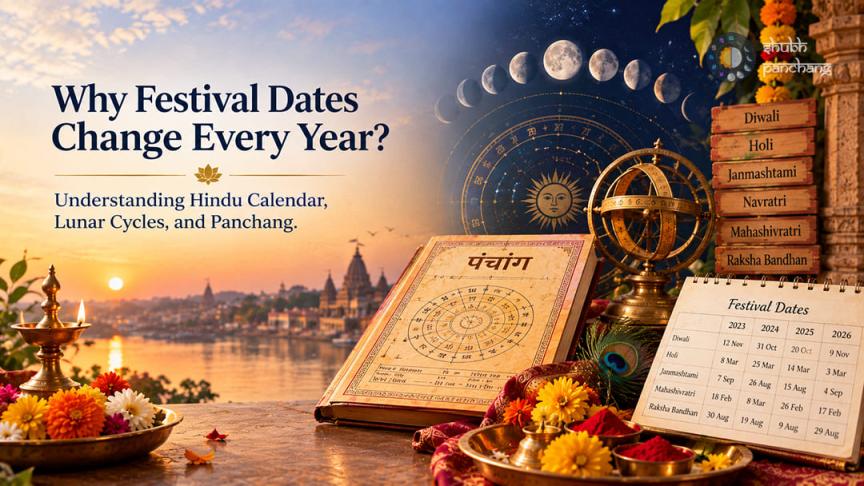
Understanding the Shift in Hindu Festival Dates
Hindu festival dates change every year because they are determined by the lunar calendar rather than the solar-based Gregorian calendar. While the common calendar used globally tracks the Earth’s movement around the Sun, festivals such as Holi, Diwali, and Janmashtami are fixed according to the specific positions of the Moon. This creates a natural variance of approximately 11 days per year between the two systems. For instance, Diwali is always celebrated on the Amavasya of the month of Kartik, but because the lunar year is shorter than the solar year, that Amavasya falls on a different Gregorian date each time. This astronomical shift ensures that festivals remain connected to their specific tithis or lunar days, which are the fundamental units of timekeeping in Vedic traditions.
Gregorian Solar vs. Hindu Luni-Solar Calendars
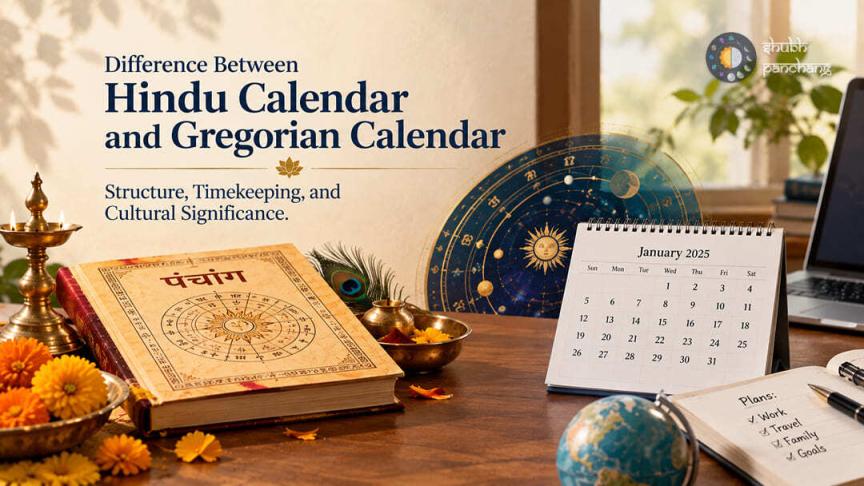
The primary difference between these systems is that the Gregorian calendar is purely solar, while the Hindu calendar is luni-solar. A solar year consists of approximately 365.24 days, whereas a lunar year, comprised of 12 lunar months, is roughly 354 days. According to the Surya Siddhanta, this 11-day gap would eventually cause festivals to drift out of their respective seasons if not for corrective measures. To prevent a festival like Holi from occurring in the middle of winter over several decades, the Hindu system employs a complex synchronization method. This is why you might notice a festival moving 'backward' by about 11 days for two consecutive years before 'jumping' forward after an intercalary month is added to the cycle.
The Role of Tithi in Timing Festivals
A Tithi is the duration in which the longitudinal angle between the Moon and the Sun increases by 12 degrees. Unlike a standard Gregorian day that always lasts 24 hours, a Tithi can vary between 19 and 26 hours depending on the speed of the Moon in its orbit. Hindu festivals are tied to these Tithis rather than fixed dates. For example, Raksha bandhan is observed on the Shravan Purnima Tithi. Because a Tithi can begin at any time of the day or night, the Panchang uses the Udaya Tithi principle—the Tithi prevailing at the time of sunrise—to determine the primary day of celebration. This precise calculation ensures that the spiritual and astronomical alignment of the ritual is preserved.
Shukla Paksha and Krishna Paksha Explained
Lunar phases are divided into two distinct fortnights known as Pakshas, which dictate the timing of specific observances. The Shukla Paksha is the waxing phase leading to the Full Moon (Purnima), often associated with expansion and growth, while the Krishna Paksha is the waning phase leading to the New Moon (Amavasya), often linked to introspection or specific deities. Many major festivals occur during specific Pakshas; for example, Maha Shivratri is observed on the Chaturdashi of the Krishna Paksha in the month of Phalguna. The movement of the Moon through these phases is predictable but does not align perfectly with the seven-day week or the 30/31-day month of the Gregorian system, causing the perceived date shifts.
How Adhik Maas Synchronizes the Calendar
Adhik Maas, or the 'extra month,' is the mechanism used to realign the lunar calendar with the solar year every 32.5 months. Since the lunar year is 11 days shorter than the solar year, the gap widens to about a full month after roughly three years. To correct this, an additional month is inserted into the Hindu calendar, as prescribed in texts like the Muhurta Chintamani and Dharmasindhu. This leap month ensures that seasonal festivals like Vasant Panchami always fall in the spring and Sharad Purnima remains in the autumn. Without Adhik Maas, the entire socio-religious fabric of India, which is deeply rooted in seasonal agriculture and nature cycles, would lose its chronological relevance.
Solar-Based Festivals and Makar Sankranti
Certain Hindu festivals stay relatively fixed on the Gregorian calendar because they are based on solar transitions rather than lunar phases. Makar Sankranti is the most prominent example, as it marks the Sun's entry into the zodiac sign of Capricorn (Makara). Because this event follows the solar cycle (Suryasidhhanta), it consistently falls on January 14th or 15th. Similarly, festivals like Baisakhi or Pongal, which are tied to the solar harvest cycle, do not experience the 11-day shift seen in lunar festivals like Janmashtami. This distinction highlights the sophisticated dual-tracking system of the Panchang, which monitors both lunar and solar energies.
Regional Variations in Panchang Calculations
Differences in regional traditions such as the Purnimanta and Amanta systems can lead to variations in how festival dates are recorded. In the Purnimanta system, common in North India, the month ends with the Full Moon (Purnima). In the Amanta system, followed in states like Gujarat and Maharashtra, the month ends with the New Moon (Amavasya). While the astronomical moment of a Tithi like 'Kartik Amavasya' is the same for everyone, the name of the month in which it falls might differ between these two systems. Furthermore, calculations based on local sunrise times mean that a Tithi might start just after sunrise in one city and just before in another, occasionally leading to a one-day difference in celebration dates across regions.
Calculation Accuracy through Drik Ganit
Modern Panchangs use the Drik Ganit (Drik Siddha) method to ensure the highest accuracy in predicting festival dates. This method involves observing the actual positions of celestial bodies and aligning them with mathematical models, rather than relying solely on ancient static tables. By using Drik Ganit, astrologers can pinpoint the exact start and end times of Tithis, Nakshatras, and Yoga. This scientific approach ensures that when you check a festival date, it corresponds precisely with the physical reality of the Moon's position in the sky, maintaining the integrity of the 3-Check Muhurat Method which factors in Tithi, Choghadiya, and Rahu Kaal for daily planning.
The Spiritual Significance of Lunar Cycles
Following the lunar calendar is a practice of aligning human life with the rhythms of nature and the cosmos. Traditional Hindu thought suggests that the Moon significantly influences the human mind (Manas) and the Earth's tides; therefore, performing rituals on specific Tithis maximizes their spiritual efficacy. The changing dates are not a sign of randomness but a reflection of a dynamic universe where time is not a rigid linear progression but a series of cycles. By observing festivals according to the Moon, devotees participate in a tradition that has harmonized spiritual practice with astronomical reality for thousands of years, as documented in the Nirnaya Sindhu.