



Understanding the Role of Choghadiya in Daily Life
Choghadiya is a traditional Hindu system of time division used to identify auspicious and inauspicious periods for starting significant daily activities. Unlike complex horoscopes that require a deep understanding of birth charts, Choghadiya provides a simplified, accessible way to check the quality of time at any given moment. It is particularly valued when an immediate decision or action is required and a detailed Muhurat cannot be calculated by a priest. By categorizing time into specific blocks, this system helps individuals align their ventures with favorable cosmic influences, ensuring that beginnings are made with positive intent and structural harmony.
The Meaning and Etymology of Choghadiya
The term Choghadiya is derived from the Hindi words 'Cho' (meaning four) and 'Ghari' (an ancient unit of time). According to the Surya Siddhanta, one 'Ghari' is equivalent to 24 minutes. Therefore, a Choghadiya represents a period of four gharis, which equals approximately 96 minutes or 1.5 hours. In the context of the Panchang, these 96-minute intervals are used to determine which planetary energies are dominant during the day and night. While the literal duration is 96 minutes, the actual length of each Choghadiya varies slightly because it depends on the fluctuating times of local sunrise and sunset.
How Choghadiya Timings Are Calculated
Choghadiya calculations are performed by dividing the total duration of daytime and nighttime into eight equal parts. The daytime period (Din-man) starts from sunrise and ends at sunset, while the nighttime period (Ratri-man) begins at sunset and ends at the following sunrise. Because the length of days and nights changes with the seasons and geographic location, the duration of each Choghadiya must be recalculated daily for specific cities. This reliance on the Drik Ganit method ensures that the timings remain accurate to the observer's actual location. The sequence of the seven types of Choghadiya changes each day of the week, following a fixed cycle mentioned in classical texts like the Muhurta Chintamani.
The Seven Types of Choghadiya and Their Significance
There are seven distinct types of Choghadiya, each classified as either auspicious (Shubh), inauspicious (Ashubh), or neutral (Char).
| Type | Quality | Traditional Meaning |
|---|---|---|
| Amrit | Auspicious | Nectar; considered the best for all types of work. |
| Shubh | Auspicious | Good; ideal for ceremonies, marriage, and education. |
| Labh | Auspicious | Gain; preferred for business and starting new ventures. |
| Char | Neutral | Mobile; suitable for travel and moving objects. |
| Rog | Inauspicious | Disease; traditionally avoided for health-related tasks. |
| Kaal | Inauspicious | Time/Death; avoided for all auspicious beginnings. |
| Udveg | Inauspicious | Anxiety; believed to cause mental stress or delays. |
Amrit, Shubh, and Labh are the most sought-after periods, while Rog, Kaal, and Udveg are generally avoided for important tasks.
Practical Usage: When to Consult the Choghadiya
Devotees and professionals often use the Choghadiya to time events that are spontaneous or require a quick window of opportunity. For example, 'Labh' is frequently chosen for opening a new bank account or signing a business contract, as it signifies financial growth. 'Amrit' is utilized for religious rituals, pujas, or taking medicine for the first time. 'Char' is specifically consulted before embarking on a journey to ensure the movement is smooth and reaches its destination without hurdles. By selecting the right block of time, practitioners believe they can mitigate potential obstacles and enhance the success of their efforts.
Distinguishing Between Choghadiya, Hora, and Rahu Kaal
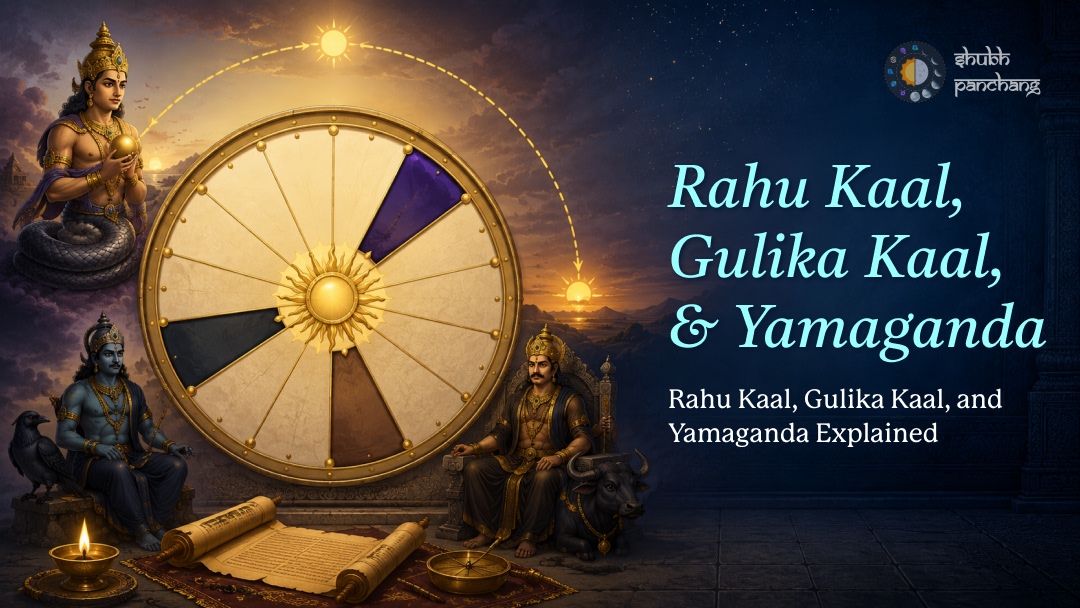
Choghadiya is distinct from other Vedic timing systems like Hora and Rahu Kaal in its structure and application. While Choghadiya divides the day into eight segments of 1.5 hours, the Hora system divides the day into 24 one-hour segments, each ruled by a specific planet. Rahu Kaal is a fixed daily window (lasting about 90 minutes) that is considered strictly inauspicious for any new start. A common practice in Vedic astrology is to ensure that even if a Choghadiya is 'Shubh' or 'Amrit', it does not overlap with Rahu Kaal. Balancing these different systems provides a more comprehensive view of the day's energetic quality.
Spiritual Perspectives and Modern Misconceptions
The spiritual philosophy behind Choghadiya is centered on the concept of 'Kaal-Bela' or the rhythm of time. It encourages a state of mindfulness, reminding individuals that there is a time for action and a time for patience. A common misconception is that a 'Shubh' Choghadiya acts as a magic charm for success. In reality, traditional teachings emphasize that auspicious timing is a supportive factor, but it does not replace the necessity of hard work, ethical conduct, and proper planning. The system is meant to provide confidence and mental clarity, helping one approach important moments with a sense of alignment with natural laws.
Accessing Choghadiya in the Digital Era
In the past, people relied solely on printed almanacs or local priests to determine the current Choghadiya. Today, modern technology has made this wisdom accessible through websites and dedicated Panchang applications. These digital tools automatically calculate the precise daytime and nighttime divisions based on the user's GPS location, accounting for variations in sunrise and sunset. This allows modern practitioners to integrate ancient timekeeping into their fast-paced lives, whether they are in Mumbai, New York, or London, ensuring that tradition remains relevant and practically useful in a globalized world.
Conclusion: Living in Harmony with Vedic Rhythms
Choghadiya represents a profound aspect of Indian culture that seeks to bridge the gap between human activity and cosmic cycles. By understanding the meaning of Amrit, Shubh, and Labh, and respecting the cautionary nature of Rog and Kaal, individuals can navigate their daily lives with greater awareness. It serves as a practical tool for those looking to infuse their actions with spiritual significance and positivity. Ultimately, the practice of checking Choghadiya is about more than just 'good luck'; it is about honoring the sanctity of time and approaching every new beginning with respect, preparation, and hope.