






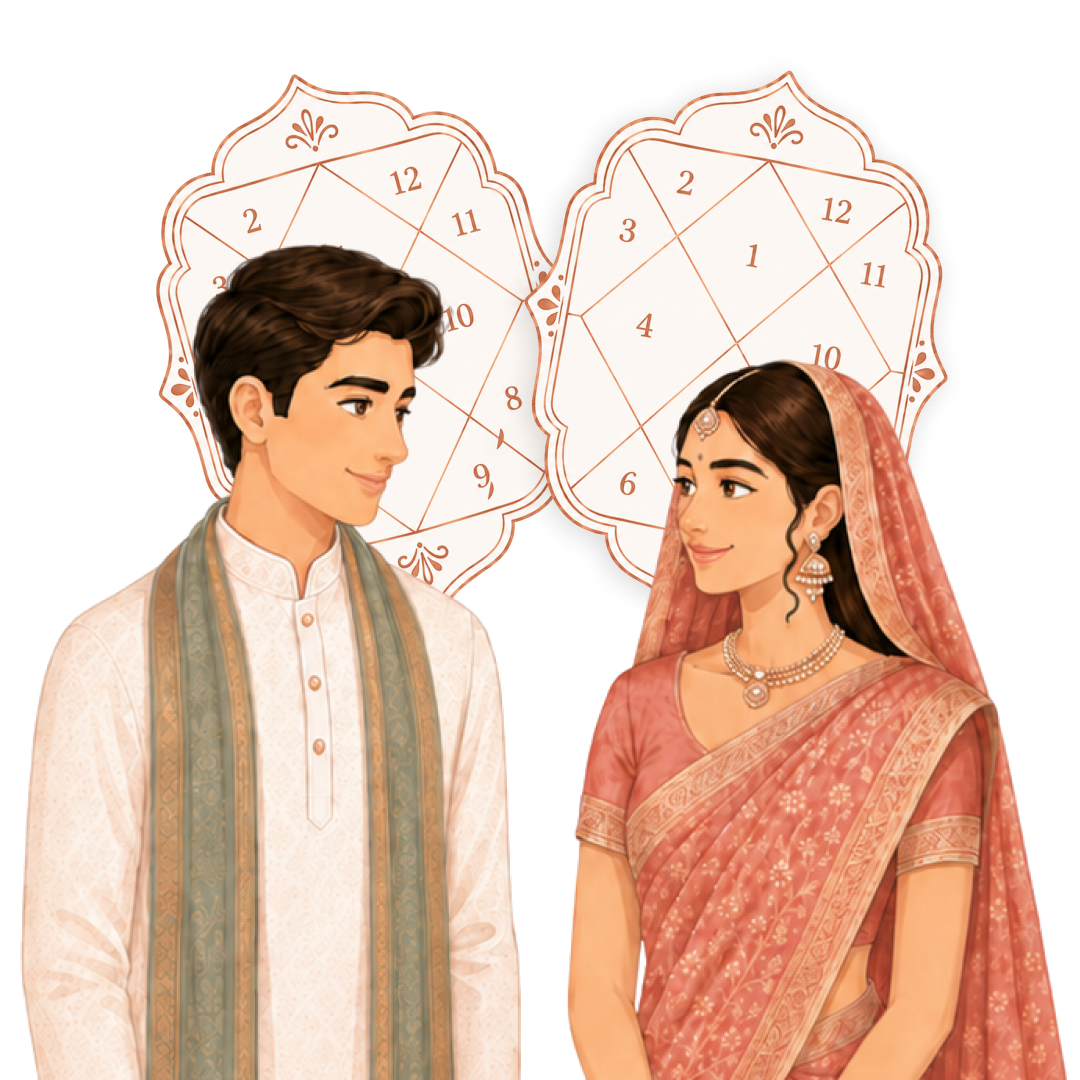
Kundali Matching Calculator – 36 Gun Milan as per Ashtakoota Method
निर्विघ्नं कुरु मे देव सर्वकार्येषु सर्वदा॥
The Kundali Matching Calculator is based on the traditional Ashtakoota Milan system of Vedic astrology. By entering the birth details of both the boy and the girl, you can instantly check marriage compatibility and get a score out of 36 Gunas.
How kundali matching works
Kundali matching compares the bride's and groom's birth charts and scores the pair out of 36 gunas. The method is called Ashtakoota, meaning eight kootas, because the 36 points are split across eight separate checks. Most families and pandits treat 18 gunas as the minimum for going ahead.
All eight checks use just two things from each chart: the nakshatra (birth star) the Moon was in at birth, and the Moon's rashi (sign). That is why two people born a day apart can get very different scores with the same partner.
Most people get here with a biodata in hand, sent by a relative or a matrimony site, and want a first answer before anyone meets. The gun milan score is a good first filter. Read it together with the dosha rows, though. A strong total with a zero in Nadi needs a closer look, and a low total can still work if a traditional exception applies.
The 8 kootas and their points
The eight kootas carry 1 to 8 points each and add up to 36. The rules come from the muhurta texts that panchang makers still follow, of which Muhurta Chintamani is the best known.
| Koota | Points | What it compares | Based on |
|---|---|---|---|
| Varna | 1 | Temperament and outlook | Moon sign |
| Vashya | 2 | Mutual attraction, who influences whom | Moon sign |
| Tara | 3 | Count between the two birth stars; luck and well-being | Nakshatra |
| Yoni | 4 | Physical and intimate compatibility (each nakshatra has an animal symbol) | Nakshatra |
| Graha Maitri | 5 | Friendship between the two Moon sign lords; mental wavelength | Sign lord |
| Gana | 6 | Nature: Deva, Manushya or Rakshasa | Nakshatra |
| Bhakoot | 7 | Distance between the two Moon signs; family life, money, children | Moon sign |
| Nadi | 8 | Health and children, in tradition | Nakshatra |
| Total | 36 |
The weights climb steeply. Gana, Bhakoot and Nadi alone hold 21 of the 36 points. A couple can score well on the first five kootas and still fall under 18 if Bhakoot and Nadi both come out at zero.
You may see half points in your report, such as 1.5 in Tara. We count the stars from the girl's nakshatra to the boy's and from the boy's to the girl's, then average the two. If you don't know your birth star, the birth star calculator will tell you. For your Moon sign, the rashi used in Varna, Vashya and Bhakoot, use the Moon sign calculator.
How many gunas are good for marriage
| Gunas | What it traditionally means |
|---|---|
| 0 to 17 | Below the traditional minimum. Most families won't go ahead without having both charts read in full. |
| 18 to 24 | Average match. Usually accepted if Nadi and Bhakoot are not zero. |
| 25 to 32 | Good match. |
| 33 to 36 | Excellent match, and rare. |
A good total doesn't cancel out a zero in Nadi or Bhakoot, so look at those two rows in your report before the total. If the score is fine and both families are happy, the next job is the date. Our marriage muhurat list has every vivah date of the season with its time window.
Nadi dosha
Nadi dosha means both partners have the same nadi, so the Nadi koota scores 0 out of 8. There are three nadis, Adi, Madhya and Antya, and each of the 27 nakshatras belongs to one of them. Tradition links Nadi with health and children, which is why families take a zero here seriously.
Many astrologers hold that the dosha does not apply, or is much weaker, when:
- both share a Moon sign but have different nakshatras;
- both share a nakshatra but have different Moon signs, which only happens with nakshatras that span two signs, such as Krittika, Mrigashira or Punarvasu;
- both share a nakshatra but were born in different charanas (quarters) of it.
These exceptions come from tradition, and astrologers apply them differently. Our calculator shows the plain score, so a same-nadi couple will see 0 even when one of them fits. In that case, show both charts to an astrologer you trust before deciding.
Bhakoot dosha
Bhakoot looks at how far apart the two Moon signs are. Counting from one partner's sign to the other's, a 2/12, 5/9 or 6/8 relationship scores 0 out of 7, and every other pairing gets the full 7. Tradition ties 6/8 (shadashtak) to friction and health, 2/12 to money and 5/9 to children.
The exception most astrologers accept is when both Moon signs share a ruling planet, or their rulers are friends. Aries and Scorpio, for example, are 6/8 from each other, but Mars rules both. If your report shows 4 or 5 in Graha Maitri, the two sign lords are the same or friendly. Our report doesn't apply this exception on its own, so treat a zero in Bhakoot as a reason to check, not an automatic no.
Mangal dosha in matching
Mangal dosha, or being manglik, is checked separately from the 36 gunas. A chart is usually called manglik when Mars sits in the 1st, 4th, 7th, 8th or 12th house from the ascendant. Some traditions, especially in the South, add the 2nd house, and some also count from the Moon and Venus.
The old rule in matching is that a manglik marries a manglik, which is believed to balance the dosha. Many astrologers also treat it as weaker when Mars is in its own sign (Aries, Scorpio) or exalted in Capricorn, though the rules vary from one pandit to the next. The guna report on this page doesn't look at Mars, so check each person with the Mangal dosha calculator. That check depends on the ascendant, so it needs an accurate birth time.
If you don't know the exact birth time
The form asks for a birth time, but an approximate one is often enough for the 36 guna score. All eight kootas depend only on the Moon, which spends about a day in each nakshatra and about two and a quarter days in each sign.
Here's a quick test. Run the match twice for the same date, once with a morning time and once with an evening time. If the total and all eight rows stay the same, the score holds without the exact time. If they change, the Moon moved into a new nakshatra that day, and you'll need the real time or an astrologer's help with birth time rectification. Mangal dosha can't be handled this way, because the ascendant changes roughly every two hours.
Matching by name
This calculator works from date, time and place of birth. The names you type only label the report and play no part in the calculation.
Name matching is an older method for when birth details aren't known. The first syllable of the name points to a nakshatra pada (each pada has its own sound; Ashwini's are Chu, Che, Cho and La), and the kootas are scored from that. It's a rough guide at best. Unless the name was chosen from the birth star, its first sound often points to a different nakshatra from the one the Moon was actually in. If you have the birth date, use it.
What to do if the gunas are low
A score under 18 means look closer. It isn't a final answer. Start with the rows that scored zero. A zero in Nadi or Bhakoot may fall under one of the exceptions above. A zero in Varna or Vashya costs only 1 or 2 points, and few astrologers would turn down a proposal over that.
Next, have both full charts read. The guna score ignores the 7th house, its lord, Venus and the running dasha, which many astrologers weigh more heavily than the koota total. Doshas such as Kaal Sarp dosha also sit outside the score and are read in each chart on its own. Some families have a shanti puja done for peace of mind, such as Nadi dosha nivaran or Mangal shanti. These are traditional options, not requirements.
Plenty of couples marry with a low score, or without matching at all. The gunas are one input. The two people, their families and how they work through disagreements count for just as much.
How this calculator works out the score
We calculate both charts with the Swiss Ephemeris and the Lahiri ayanamsa. Lahiri is the ayanamsa India's Calendar Reform Committee adopted in 1955, and the government's Rashtriya Panchang still uses it. From each chart we take the Moon's nakshatra and sign, then score the eight kootas with the standard Ashtakoota tables.
Each koota card in the report shows what was compared for both of you, such as each person's Moon sign or nadi, so a row can be checked by hand. The place of birth sets the time zone and coordinates. Enter the town where the person was born, not where they live now.