
Overview
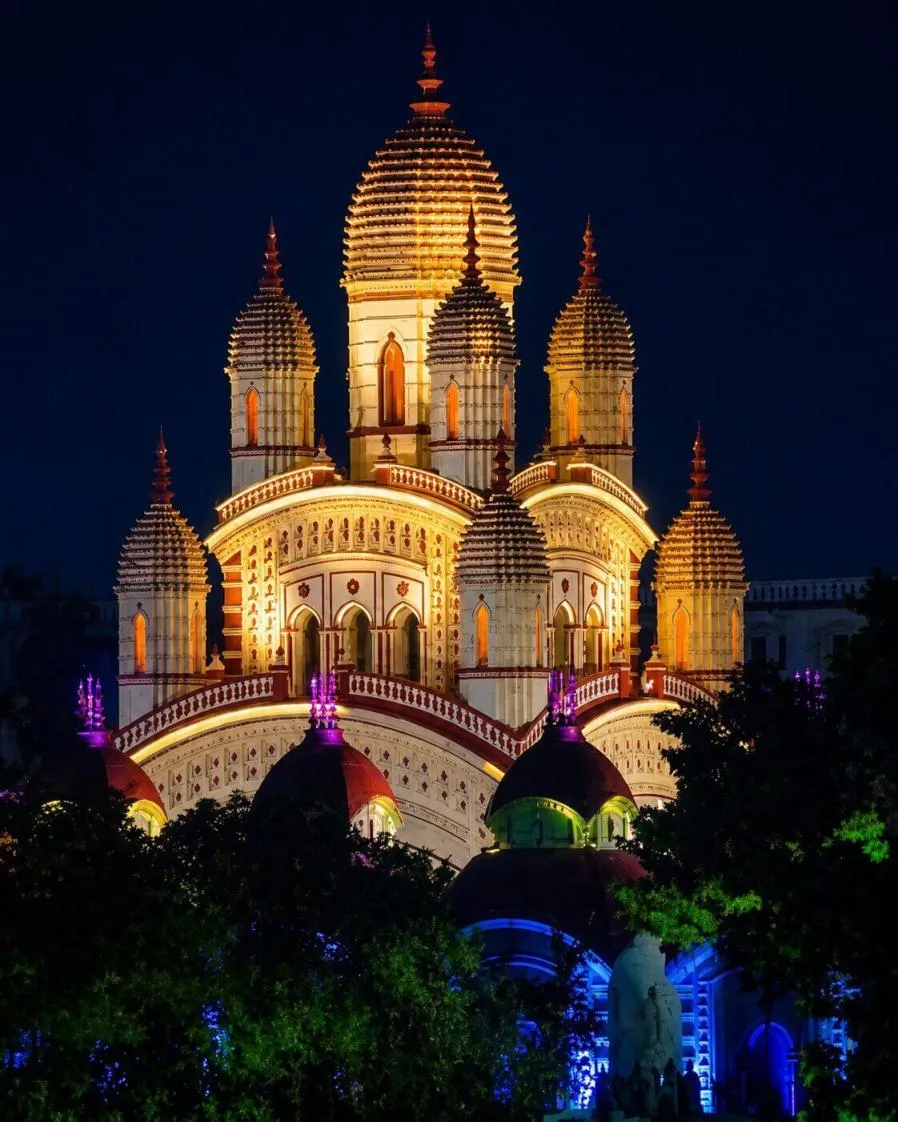
Kalighat Kali Temple is a Hindu temple in the Kalighat neighbourhood of south Kolkata, dedicated to the goddess Kali and counted among the 51 Shakti Peethas of the Indian subcontinent. The goddess is worshipped here in her Dakshina Kali form, and her consort is present as Bhairava in the form of Nakuleshwar Mahadev. It stands on the bank of the Adi Ganga, once a live channel of the Hooghly, and its name is widely linked to the origin of the city's own name, Kolkata, believed to derive from Kalikata, meaning the ghat or landing place of Kali. The building in its present form was completed in 1809, though the site's association with Kali worship goes back several centuries earlier through references in Bengali literature. Pilgrims arrive through the year for darshan, with the heaviest crowds gathering on Tuesdays, Saturdays, and during Kali Puja.
Legend & Mythology
The Puranic account behind every Shakti Peetha begins with Sati, who immolated herself after her father Daksha insulted her husband Shiva at a yajna. Shiva's grief turned into the Tandava, a dance of destruction violent enough to threaten the balance of creation, and he carried her body across the sky as he danced. Vishnu intervened with his Sudarshan Chakra, cutting the body into pieces that fell across the subcontinent; each spot where a piece landed became a Shakti Peetha, with the goddess and a form of Shiva as Bhairava enshrined together there. Temple tradition holds that the toes of her right foot fell at this site on the bank of the Adi Ganga, which is why the goddess here is called Dakshina Kali and the guardian Bhairava is worshipped as Nakuleshwar Mahadev.
A separate strand of temple tradition credits the founding of the shrine to Chouranga Giri, a wandering ascetic who, according to this account, found an impression of the goddess in the marshland near the river and built the first modest structure to house it. Local tradition also connects the name of Kolkata's Chowringhee area to this ascetic. Devotees today carry both threads together, the cosmic story of Sati's fall and the more local memory of a sadhu's discovery, as the reason this stretch of riverbank became a place of pilgrimage.
Historical Journey
Written references to a Kali shrine at this location appear in Bengali literature well before the current building existed, including the 15th-century Mansar Bhasan and the 17th-century Kavi Kankan Chandi. These texts show the site was already known as a place of goddess worship for generations before today's structure was built. Historical accounts describe an earlier structure raised under royal patronage in the early 16th century, though little of that structure survives today. The temple that stands now was commissioned by Santosh Roy Chowdhury of the Sabarna Roy Choudhury family, the family long associated with landholding in the Kalighat area; construction started in 1798 and took eleven years, finishing in 1809. The Bawali Raj family also supported the temple in its early years. In 2024, a restoration project repaired the terracotta work on the outer walls and covered the three spires with close to fifty kilograms of gold, funded jointly by the Kolkata Municipal Corporation and the Reliance Foundation at a cost of roughly two hundred crore rupees.
Architecture & Sacred Geography
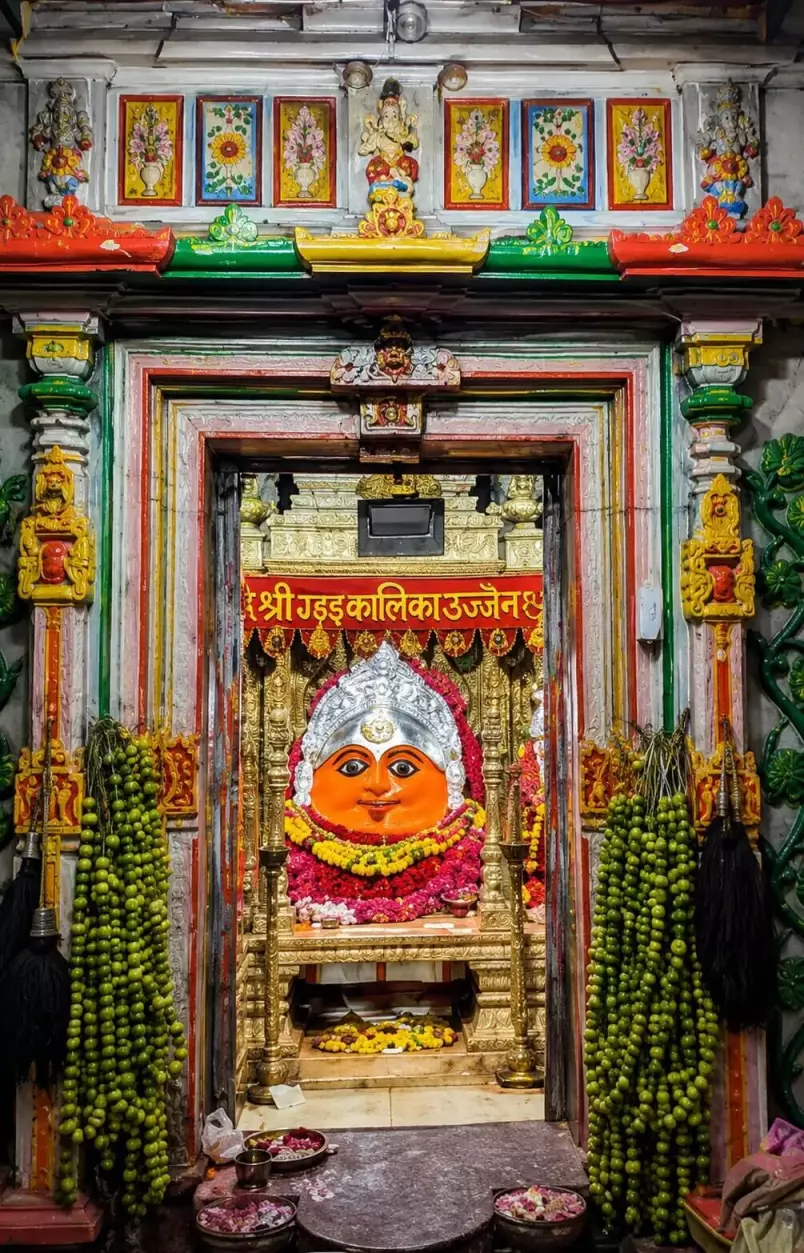
Kalighat Kali Temple is built in the ath-chala style of Bengal temple architecture, a form based on four sloping roof sections meeting at a curved ridge rather than the tiered towers common in North Indian temples. The outer walls carry a diamond chessboard pattern in alternating green and white, and the three spires above the sanctum are topped with metallic finishes bordered in yellow, red, green, and blue, now overlaid with gold following the 2024 restoration. Terracotta panels on the facade depict scenes from Hindu mythology, a craft tradition common to Bengal temples of the seventeenth to nineteenth centuries. Inside the Garbha Griha, or inner sanctum, the deity is represented not as a full anthropomorphic image but as a polished black stone carved to suggest a face, with three large eyes painted in red and a tongue made of beaten gold set between golden teeth. Temple accounts describe four arms attached to the image, two holding a sword and a severed head and the other two holding a lotus and a rosary, the standard iconography of Kali across Shakta tradition. The temple sits directly on the bank of the Adi Ganga, also called Tolly's Nullah, a channel that was once part of the main flow of the Hooghly and is treated as a sacred extension of the Ganges because of its closeness to the shrine.
Devotee Experience
Ritual worship at Kalighat follows a five-part daily cycle, opening with Mangla Aarti before dawn and closing with Shayan Aarti at night, with Bhog Aarti at midday and Sandhya Aarti in the evening in between. A visit typically moves through a queue before reaching the Garbha Griha for darshan, and wait times vary sharply between an ordinary weekday morning and a Tuesday or Saturday, when the line builds well before opening. Vendors along the approach lanes sell flowers, vermilion, and puja items for those who want to make an offering before entering. The temple sits within a dense pilgrimage quarter of south Kolkata, and a few places connected to its history and daily life lie within easy walking distance.
- Nirmal Hriday, immediately adjacent to the temple, a hospice for the destitute and dying founded by Mother Teresa in 1952
- Kalighat Metro Station, about 0.4 km away, the nearest rail link into the temple lanes
- Adi Ganga, also called Tolly's Nullah, along the temple's own bank, regarded as a sacred extension of the Ganges because of its closeness to the shrine
Photography and videography are not permitted inside the Garbha Griha where the deity is enshrined; the temple courtyard and exterior can generally be photographed. Modest, respectful clothing is expected, and footwear must be removed before entering the temple premises. Approach lanes near the temple are lined with shops selling flowers, vermilion, and puja items for those making an offering. Visitors move through a queue to reach the Garbha Griha for darshan, and queues lengthen considerably on Tuesdays, Saturdays, and during Kali Puja, so an early morning visit is generally more comfortable.
Timings
Timings can vary by season and special occasions - confirm locally before travelling.
Offerings
Devotees typically offer red hibiscus flowers, considered especially sacred to Kali, along with vermilion and sweets. Khichuri and misti doi (sweetened yogurt) are among the prasad items associated with the temple's bhog tradition.
Getting there
Kalipeeth Temple, Kolkata, West Bengal
Howrah Junction Railway Station → Kalipeeth Temple(By train)
14.5 kmfrom Howrah Junction Railway Station
Taxis, buses, or a metro connection via Esplanade link Howrah Junction onward to Kalighat.
5 kmfrom Esplanade Bus Terminus, Kolkata
State and city buses converging at Esplanade connect onward to Kalighat by bus, taxi, or the metro in 20 to 30 minutes.
24 kmfrom Netaji Subhas Chandra Bose International Airport
Prepaid taxis and app cabs at the airport are the most convenient way to cover the distance to the temple.