
Overview
Dakshineswar Kali Temple stands on the eastern bank of the Hooghly River in Kolkata, dedicated to the goddess Kali in her form as Bhavatarini. Rani Rashmoni, a zamindar from a Mahishya family, commissioned the temple in the mid-nineteenth century, and it later became closely linked with the priest Ramakrishna Paramahamsa, who served here for three decades and whose teachings drew visitors well beyond Bengal. Thousands of devotees now arrive for darshan every day, particularly during Kali Puja and other festival periods.
Legend & Mythology
According to the temple trust, Rashmoni was preparing in 1847 to travel by boat to Kashi to worship Kali when she had a dream on the eve of her planned departure. In the dream the goddess said there was no need to make the journey, and instructed her instead to install an image on the bank of the Ganges and arrange for regular worship there. Rashmoni cancelled the pilgrimage and bought a riverside plot in the village of Dakshineswar, then known as Saheban Bagicha, from an Englishman named Jake Hastie. Temple tradition holds that the years spent building a shrine to the exact design the vision had described, facing south toward the river with a sanctum large enough for the goddess and Shiva together, were an act of obedience to that instruction rather than an ordinary act of patronage. The account is why Bhavatarini, an image of Kali standing on the reclining Shiva, occupies the main shrine rather than a deity the family might otherwise have chosen, and why the temple has remained tied to her name for generations of visitors.
Historical Journey
Construction ran from 1847 to 1855, and the project is recorded to have cost about nine hundred thousand rupees, a large sum for a Bengal temple of that period. The image of Bhavatarini was installed on 31 May 1855, the day of Snana Yatra, amid festivities that drew crowds from across the region. Rashmoni appointed a Brahmin priest, Ramkumar Chattopadhyay, to conduct the daily worship, and he brought along his younger brother Gadadhar, later known as Ramakrishna Paramahamsa, and a nephew to assist him. Ramkumar died in 1856, and Ramakrishna took over as head priest, a position he held for roughly three decades. His mystical practices and teaching that different religious paths lead to the same truth drew scholars, reformers, and eventually disciples such as Swami Vivekananda, who went on to found the Ramakrishna Mission after his death in 1886.
Architecture & Sacred Geography
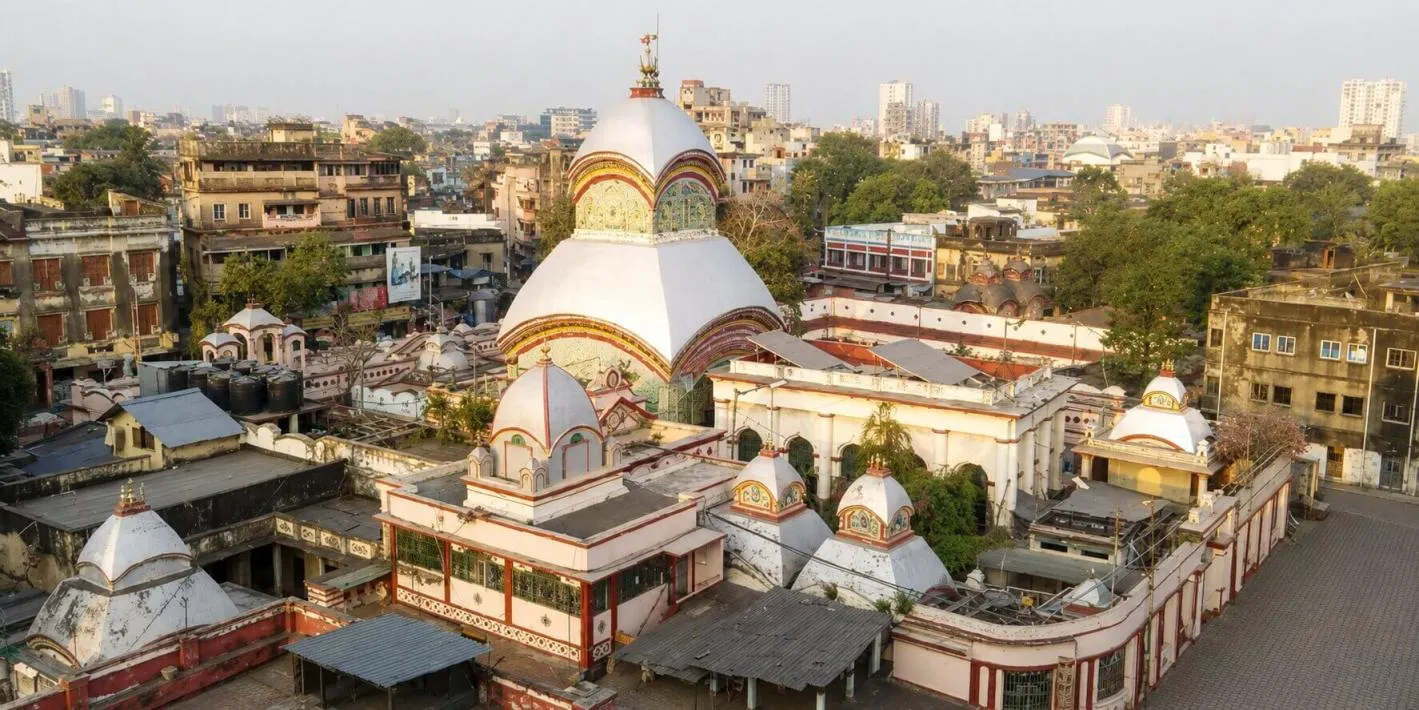
The main shrine follows the Navaratna, or nine-spire, style common to nineteenth-century Bengal temples, rising just over 30 metres on a three-storeyed base roughly 14 metres square. Nine spires sit across the upper two storeys, and a broad flight of stairs leads up to the platform, which faces south toward the river. Inside, the Garbha Griha, or inner sanctum, holds the silver-throned image of Bhavatarini standing on the chest of a reclining Shiva, both figures set on a base shaped like a thousand-petalled lotus. West of the main shrine, a row of twelve identical Shiva temples built in the aat-chala style, a curved-roof form typical of rural Bengal, faces east toward the river and flanks the ghat where pilgrims bathe before darshan. A separate shrine to the north holds images of Radha and Krishna, and a Natmandir, a pillared hall used for music and ritual performance, stands in front of the main temple. Kali, Shiva, and Krishna are therefore worshipped within one riverside courtyard, a layout that reflects the range of devotional practice the temple was built to accommodate.
Devotee Experience
Photography and mobile phones are not permitted inside the main sanctum during darshan, and visitors deposit phones, cameras, and bags at a cloakroom near the entrance before joining the queue for the goddess. A full visit, including the walk through the Shiva temples and the ghat, typically takes about one to two hours, longer during Kali Puja and other major festivals when queues extend well beyond the courtyard. Morning and evening aarti bookend the day's darshan sessions, and the sanctum closes briefly around midday for the goddess's bhog offering before reopening in the afternoon. Two sites tied to the temple's history are commonly visited on the same trip.
- Belur Math, about 4 km away, reached by a short passenger ferry across the Hooghly from the temple's own jetty, headquarters of the Ramakrishna Math founded by Ramakrishna's disciple Swami Vivekananda
- Adyapeath Ashram, about 1 km away on the same bank, a Kali-worship ashram many visitors combine with a Dakshineswar darshan
Photography and mobile phone use are not permitted inside the main sanctum during darshan, though they are generally allowed in the outer courtyard and near the ghat. Modest, respectful attire is expected, in keeping with general practice at Hindu temples in Bengal. Visitors deposit mobile phones, cameras, and bags at a cloakroom near the entrance before joining the darshan queue, and collect them again after darshan. The complex includes the main Kali shrine, twelve Shiva temples, and a Radha-Krishna temple, so plan extra time to visit the wider courtyard and the ghat.
Timings
Timings can vary by season and special occasions - confirm locally before travelling.
Offerings
Devotees typically offer flowers and sweets to Bhavatarini, and the temple kitchen prepares khichuri, a rice-and-lentil bhog, along with Bengali sweets such as sandesh and payesh, which are distributed to visitors as prasad.
Getting there
Dakshineswar Kali Temple, Kolkata, West Bengal
Dakshineswar Railway Station → Dakshineswar Kali Temple(By train)
1 kmfrom Dakshineswar Railway Station
A short walk or short auto ride from the temple entrance; trains from Sealdah on the Kalyani/Dankuni suburban line stop here.
13 kmfrom BBD Bagh / Esplanade, Kolkata city centre
Well connected to Dakshineswar via B.T. Road and Kolkata's city bus network.
13 kmfrom Netaji Subhas Chandra Bose International Airport
Taxis and app-cabs cover the route to the temple in under an hour outside peak traffic.