


Understanding the Concept of Tithi in Hindu Calendar
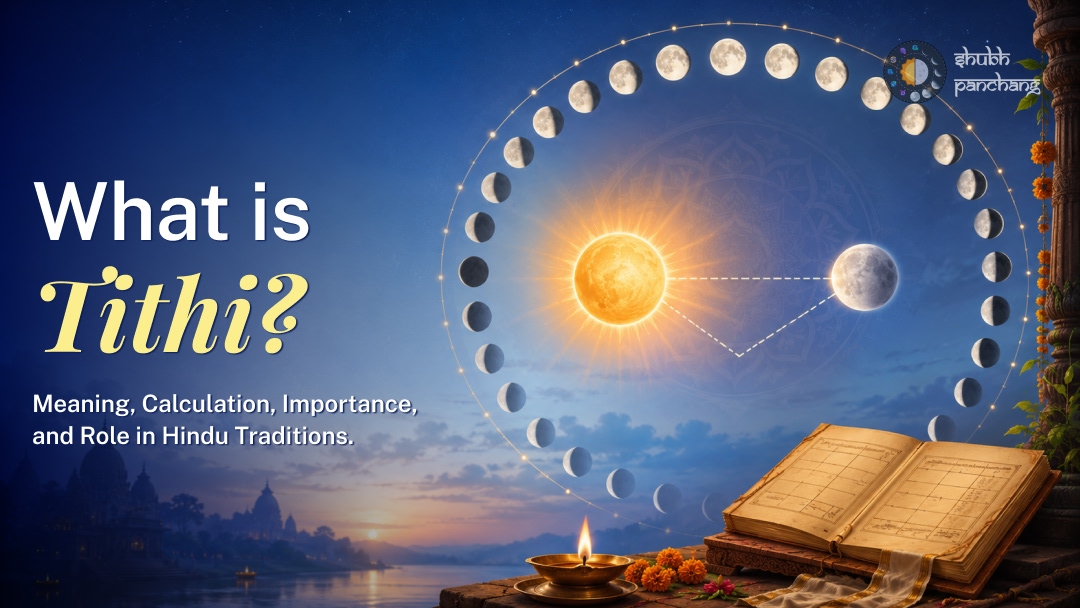
A Tithi is a lunar day in the Hindu calendar, defined by the time it takes for the longitudinal angle between the Moon and the Sun to increase by 12 degrees. Unlike the Gregorian calendar where a day is a fixed 24-hour period from midnight to midnight, a Tithi is a dynamic unit of time that depends entirely on the relative positions of the Sun and the Moon. In the Vedic timekeeping system, also known as the Panchang, Tithi is one of the five essential elements or 'angas' (limbs) used to determine the quality of time. It serves as the primary basis for calculating festivals, religious fasts (vrats), and the performance of ancestral rites. Because the Moon's velocity varies as it orbits the Earth, the duration of a Tithi is not constant; it can fluctuate between approximately 19 to 26 hours. This fluid nature means a Tithi can begin at any time of the day or night, and its start and end times rarely align perfectly with the solar sunrise. Consequently, a single Tithi can sometimes span across two sunrises, or in some cases, a Tithi may start and end between two consecutive sunrises without ever being present at the time of sunrise.
The Astronomical Calculation of a Lunar Day
The calculation of a Tithi is based on the 360-degree lunar orbit, which is divided into 30 equal segments of 12 degrees each. According to the Surya Siddhanta, the mathematical foundation of Indian astronomy, the position of the Sun and Moon must be accurately tracked to determine the current Tithi. When the Moon is exactly aligned with the Sun (0 degrees), it marks the end of Amavasya and the beginning of the lunar month. As the Moon moves ahead of the Sun, every 12-degree increment marks the completion of one Tithi. For instance, when the Moon is 12 degrees ahead, the first Tithi (Pratipada) ends. When it reaches 180 degrees directly opposite the Sun, it marks Purnima or the Full Moon. This method follows the 'Drik Ganit' or observational mathematics, ensuring that the calculated Tithi matches the visible positions of the celestial bodies in the sky. Because the Moon moves faster when it is closer to the Earth (perigee) and slower when it is further away (apogee), the time it takes to cover those 12 degrees changes, leading to the variations in Tithi duration. This astronomical precision is what allows the Vedic calendar to stay synchronized with the actual phases of the Moon.
Exploring Shukla Paksha and Krishna Paksha
A Hindu lunar month is divided into two distinct fortnights or 'Pakshas', each consisting of 15 Tithis. The first fortnight is the Shukla Paksha (Bright Fortnight), which begins after Amavasya (New Moon) and ends with Purnima (Full Moon). During this phase, the Moon appears to grow larger or 'wax' as it moves away from the Sun. The Tithis in Shukla Paksha are often considered more auspicious for expansion, growth, and starting new ventures because of the increasing lunar light. The second fortnight is the Krishna Paksha (Dark Fortnight), which begins after Purnima and ends with Amavasya. In this phase, the Moon appears to shrink or 'wane' as it moves closer to the Sun. Traditionally, the Krishna Paksha is often utilized for activities involving introspection, discipline, and the pacification of negative influences. Each Paksha follows the same naming convention for its Tithis, starting from Pratipada (1st) to Chaturdashi (14th), with the 15th Tithi being either Purnima or Amavasya depending on the phase. This cyclic nature reflects the rhythmic patterns of the natural world and is a central pillar of Hindu spiritual life.
Significant Tithis and Their Religious Importance
Every Tithi in the lunar cycle is associated with specific deities and spiritual energies, making certain days better suited for particular rituals. For example, the fourth Tithi (Chaturthi) of both Pakshas is dedicated to Lord Ganesha, with the Sankashti Chaturthi in Krishna Paksha being highly significant for removing obstacles. The eighth Tithi (Ashtami) and ninth Tithi (Navami) are deeply associated with Goddess Durga and Lord Rama, respectively. One of the most observed Tithis is the eleventh day, known as Ekadashi, which is dedicated to Lord Vishnu. Devotees observe a strict fast on Ekadashi to purify the mind and body, a practice detailed in the Padma Purana. The thirteenth Tithi (Trayodashi) is observed as Pradosham, a time dedicated to the worship of Lord Shiva. Purnima, the 15th day of Shukla Paksha, is universally regarded as auspicious for Satyanarayan Puja and major festivals like Holi and Raksha Bandhan. Conversely, Amavasya, the final day of Krishna Paksha, is considered the most potent day for 'Pitru Tarpan' or offerings to ancestors. Understanding these associations helps practitioners align their spiritual efforts with the inherent energy of the day.
Role of Tithi in Determining Festivals and Vrats
Hindu festivals are primarily Tithi-based, which is why they do not fall on the same date in the Gregorian calendar every year. For instance, Mahashivratri is observed on the Chaturdashi of Krishna Paksha in the month of Phalguna, while Diwali is celebrated on the Amavasya of Kartika month. The determination of a festival date involves a complex rule known as 'Udaya Tithi'—the Tithi that is prevailing at the time of sunrise is generally considered the Tithi for the entire day for ritual purposes. However, certain festivals are determined by the Tithi prevailing at a specific time of day or night. For example, if a ritual must be performed at midnight (like Nishita Kaal Puja for Janmashtami), the Tithi prevailing at midnight is prioritized over the sunrise Tithi. This is where the expertise of the Dharmasindhu and Nirnaya Sindhu texts becomes essential, as they provide the 'Nirnaya' or decision-making rules for when a festival should be observed if a Tithi spans across two days. This nuanced approach ensures that religious observances are conducted at the most astrologically potent moments.
Why Tithi Timings Vary by Location and Time
A common point of confusion for beginners is why Tithi timings vary between cities, such as Delhi and New York. While the astronomical moment the Moon completes its 12-degree movement is the same globally in terms of absolute time (UTC), the local time of that occurrence changes based on the time zone. Furthermore, the concept of 'Udaya Tithi' makes the local sunrise time critical. Since sunrise occurs at different moments in different geographical locations, the Tithi prevailing at sunrise in Mumbai might be different from the Tithi prevailing at sunrise in London. This geographical dependency is why a traditional Panchang Utilities tool is necessary to calculate accurate local timings. Without accounting for longitude and latitude, one might observe a fast or festival on the wrong day. The practice of using a local Panchang ensures that the individual remains in sync with the actual solar and lunar cycles of their specific environment, honoring the Vedic principle that time and space are interconnected.
How to Use Tithi for Selecting Shubh Muhurat
In the science of Muhurat (Electional Astrology), Tithi is used alongside Nakshatra, Yoga, Karana, and Vaar to find the most auspicious time for an event. Certain Tithis are classified as 'Siddha' (Accomplished), 'Jaya' (Victorious), or 'Bhadra' (Prosperous), making them naturally favorable for activities like starting a business or entering a new home. However, some Tithis are classified as 'Rikta' (Empty), specifically the 4th, 9th, and 14th Tithis. These are traditionally avoided for important material beginnings as they are thought to lack the stability needed for long-term success. Additionally, some Tithis are considered 'Galagraha' or 'Dagdha' (burnt) for specific activities. When selecting a Muhurat, astrologers also check if a Tithi is 'Kshaya' (truncated/lost) or 'Vriddhi' (increased/doubled). A Kshaya Tithi occurs when a Tithi starts after one sunrise and ends before the next, effectively 'disappearing' from the sunrise-based count. A Vriddhi Tithi occurs when a Tithi covers two consecutive sunrises. These anomalies are carefully accounted for in the Muhurta Chintamani to ensure that no vital ritual is performed during an inauspicious overlap.
The Spiritual and Ayurvedic Connection to Lunar Phases
Beyond calendar dates, Tithi represents the changing 'Kalas' or digits of the Moon, which are believed to influence the human psyche and physiological states. Traditional Ayurvedic wisdom suggests that the movement of fluids in the body, much like the tides in the ocean, is influenced by the lunar phase. During the waxing phase leading to Purnima, the 'Soma' or cooling, nourishing energy is thought to increase, making it a good time for rejuvenation and strengthening treatments. During the waning phase toward Amavasya, the body is said to undergo a natural detoxification process. Spiritually, the Tithis act as a map for the mind's journey. High-energy Tithis like Purnima can amplify both positive and negative emotions, which is why meditation and peaceful activities are recommended during these times. By following the Tithi cycle, an individual can align their diet, lifestyle, and spiritual practices with the natural ebb and flow of lunar energy, leading to a more harmonious existence that respects the rhythms of the cosmos.
Modern Methods to Track Tithi and Panchang
While in the past, people relied solely on printed wall calendars or the local temple priest to know the daily Tithi, modern technology has made this information accessible to everyone instantly. Digital Panchangs and mobile applications now provide real-time Tithi data based on the user's precise GPS location. This is particularly helpful for the global Hindu diaspora who need to adjust traditional timings to different time zones. To check the Tithi today, one should look for the 'Tithi End Time' provided in a reliable digital Panchang. If the Tithi ends in the middle of the day, the next Tithi begins immediately. It is also helpful to note the 'Vrat Tithi', which may sometimes differ from the 'Udaya Tithi' based on specific sectarian rules (such as Vaishnava vs. Smarta Ekadashi rules). By combining ancient scriptural wisdom with modern calculation tools, anyone can maintain their connection to traditional Hindu timekeeping and ensure their rituals are performed with precision and devotion.