


What is Vishwakarma Jayanti?
Vishwakarma Jayanti is a Hindu festival dedicated to Lord Vishwakarma, the divine architect and celestial engineer who crafted the universe's structure according to Vedic tradition. It is primarily observed on Kanya Sankranti, which typically falls in mid-September, marking the Sun's transition from Simha Rashi to Kanya Rashi. Unlike many Hindu festivals that follow the lunar calendar, Vishwakarma jayanti is often calculated using the solar calendar, making it a significant date for artisans, craftsmen, and industrial workers across India. Lord Vishwakarma is revered as the 'Swayambhu' or self-manifested creator who designed the celestial palaces of the gods and the powerful weapons they wielded in ancient lore.
The Mythological Origins of the Divine Architect
Lord Vishwakarma is recognized in the Rig Veda as the ultimate reality and the abstract personification of creative power. According to the Sthapatya Veda, he is the patron deity of all mechanical arts and civil engineering. His architectural mastery is credited with the creation of several legendary cities and structures mentioned in the Puranas and Epics. He built the golden city of Lanka for Ravana, the majestic Dwarka for Lord Krishna, and the opulent Indraprastha for the Pandavas. Furthermore, he is the craftsman behind the Pushpak Vimana (the flying chariot) and the divine weapons like Lord Shiva’s Trishul and Lord Vishnu’s Sudarshana Chakra. These accounts establish him as the source of all technical knowledge and aesthetic design in the Hindu cosmos.
Symbolism of Lord Vishwakarma in Vedic Tradition
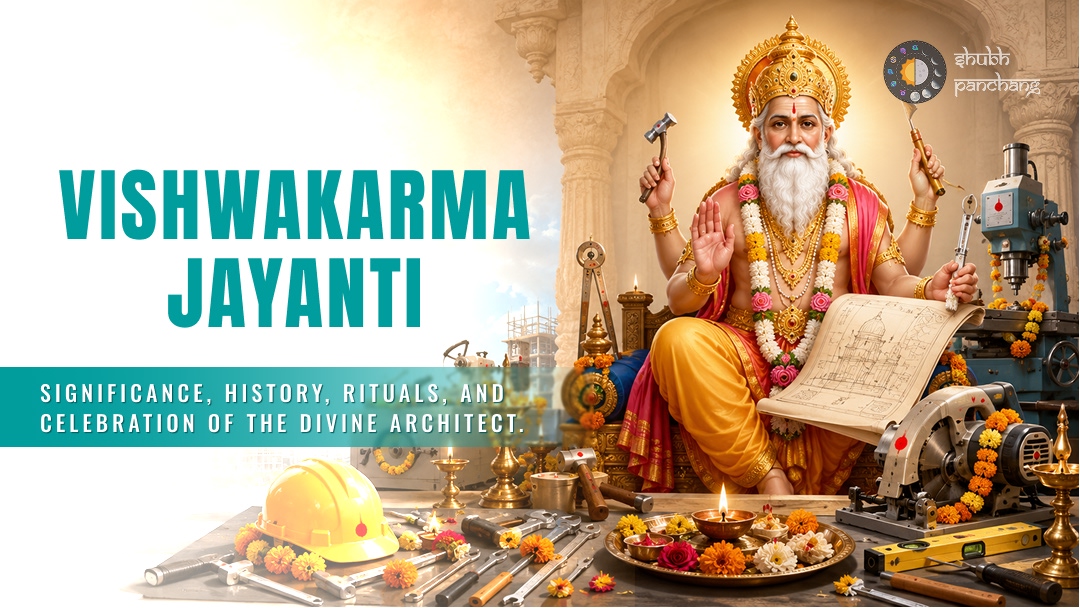
Lord Vishwakarma symbolizes the intersection of spirituality and physical labor, representing the divine potential within human creativity and technical skill. He is often depicted with four arms, holding a book, a noose, a measuring tape, and various tools, which signify knowledge, discipline, precision, and the execution of work. As the deity of innovation, he embodies the principle that every act of construction or creation is a sacred endeavor. In the context of Hindu philosophy, honoring Vishwakarma is an acknowledgment that human progress through technology and architecture is a reflection of divine order. He represents the Sthapatya (architecture) and Vastu Shastra (science of architecture), providing the structural framework that allows society to flourish.
Core Rituals and Shastra Puja Vidhi
The central ritual of Vishwakarma Jayanti is the Shastra Puja, where tools, machinery, and instruments are cleaned, decorated, and worshipped. Devotees begin the day by performing a symbolic bath and then cleaning their workplaces, whether they are large factories or small home workshops. An image or idol of Lord Vishwakarma is installed, often near the main machinery. Offerings of flowers, sweets, and fruits are made while chanting specific mantras from the Vishwakarma Purana. A critical tradition is the 'rest' given to tools; most craftsmen and engineers refrain from using their machinery on this day, showing respect for the instruments that provide their livelihood. This practice emphasizes the belief that tools are not mere objects but extensions of divine energy that deserve gratitude.
Celebrations Across Industries and Workplaces
Factories, industrial estates, and workshops across India transform into vibrant spaces of worship during this festival. In modern industrial hubs, management and workers join together to perform the puja, fostering a sense of community and shared purpose. Heavy machinery is often draped in marigold garlands, and the workspace is purified with Ganga Jal. Beyond the ritualistic aspects, many organizations use this day to organize community feasts (Bhandaras) and cultural programs. In construction sites, garages, and even software firms, the day serves as an annual 'reset' to appreciate the technical infrastructure that enables modern life. This collective observance reinforces the dignity of labor and the importance of maintaining high standards in craftsmanship.
Regional Variations in Celebration
While the core significance remains the same, regional customs for Vishwakarma Jayanti vary significantly across the Indian subcontinent. In West Bengal, Odisha, Bihar, and Jharkhand, the festival is celebrated with immense fervor on Kanya Sankranti, often involving elaborate pandals and kite-flying competitions. In southern states like Karnataka and Tamil Nadu, the worship of tools is sometimes integrated with Ayudha Puja during the Navratri festival, although many professional communities still observe the specific September date. In Western India, particularly Gujarat and Rajasthan, Vishwakarma is revered as the patron deity of the Suthar and Gajjar communities, who are traditionally involved in carpentry and stone carving. These variations highlight how the deity is woven into the diverse cultural and professional fabrics of India.
Modern Relevance for Engineers and Technicians
In the contemporary era, Vishwakarma Jayanti has evolved to include modern professions such as software engineering, aerospace technology, and digital design. While the ancient texts speak of palaces and chariots, modern professionals view the festival as a time to honor the logic, mathematics, and hardware that drive the digital age. It is common to see computer systems, servers, and laboratory equipment being included in the puja. The festival serves as a reminder that regardless of the complexity of the technology, the fundamental spirit of creation and the need for ethical, precise work remains unchanged. It bridges the gap between ancient Vedic sciences and modern technological advancements, proving that technical skill is a timeless human virtue.
Clarifying Common Misconceptions
A common misconception is that Vishwakarma Jayanti is only for factory workers or manual laborers; however, it actually encompasses all forms of constructive work and creativity. Anyone who creates—whether a software coder, a chef, a writer, or an architect—can find relevance in the worship of Lord Vishwakarma. Another misunderstanding is the date of observance; while the mid-September solar date is the most common, some regions observe 'Rishi Panchami' or the day after Diwali as Vishwakarma Puja. Understanding these nuances helps in appreciating the festival's inclusivity. It is not a day of fear-based superstition but a day of gratitude and a celebration of the human ability to transform raw materials into useful structures and objects.
The Spiritual Value of Honest Craftsmanship
The spiritual essence of Vishwakarma Jayanti lies in the sanctification of work and the pursuit of excellence through discipline. By treating tools as sacred, the practitioner is encouraged to maintain them with care and use them with integrity. This aligns with the concept of 'Karma Yoga,' where work performed with dedication and without ego becomes a path to spiritual growth. The festival reminds society that every bridge built, every machine designed, and every home constructed contributes to the collective well-being. Ultimately, Vishwakarma Jayanti beautifully celebrates the balance between material progress and spiritual values, reminding us that the tools we use are instruments for building a better, more harmonious world.