


What is Rishi Panchami and its Significance?
Rishi Panchami is a sacred Hindu fast observed on the fifth day of the Shukla Paksha in the month of Bhadrapada to honor the Sapta Rishis or the seven great sages. Unlike many other festivals that celebrate a specific deity, this day is dedicated to the spiritual lineage and the purification of the self. According to the Dharmasindhu, the primary objective of this vrat is Prayashchitta—an act of repentance for any unintentional sins or violations of purity codes in daily life. It is primarily observed by women who seek to cleanse the body and mind while expressing gratitude toward the ancient sages who preserved the knowledge of the Vedas and Dharma for humanity. By observing this fast, devotees align themselves with the discipline and spiritual rigor exemplified by the great teachers of the Vedic era.
Timing and Calendar Placement
Rishi Panchami occurs during the Bhadrapada month, typically falling one day after Ganesh Chaturthi and two days after Hartalika Teej. Because the Hindu calendar follows the lunar cycle, the date varies each year on the Gregorian calendar, but it always remains fixed on the Panchami tithi of the waxing moon phase in Bhadrapada. The observance begins with a ritual bath during the Pratahkaal (early morning) and the puja is generally performed during the Madhyahna (midday) period. This sequence ensures that the practitioner is in a state of physical and mental cleanliness before invoking the presence of the seven sages through Vedic hymns and offerings.
The Sapta Rishis: The Seven Great Sages
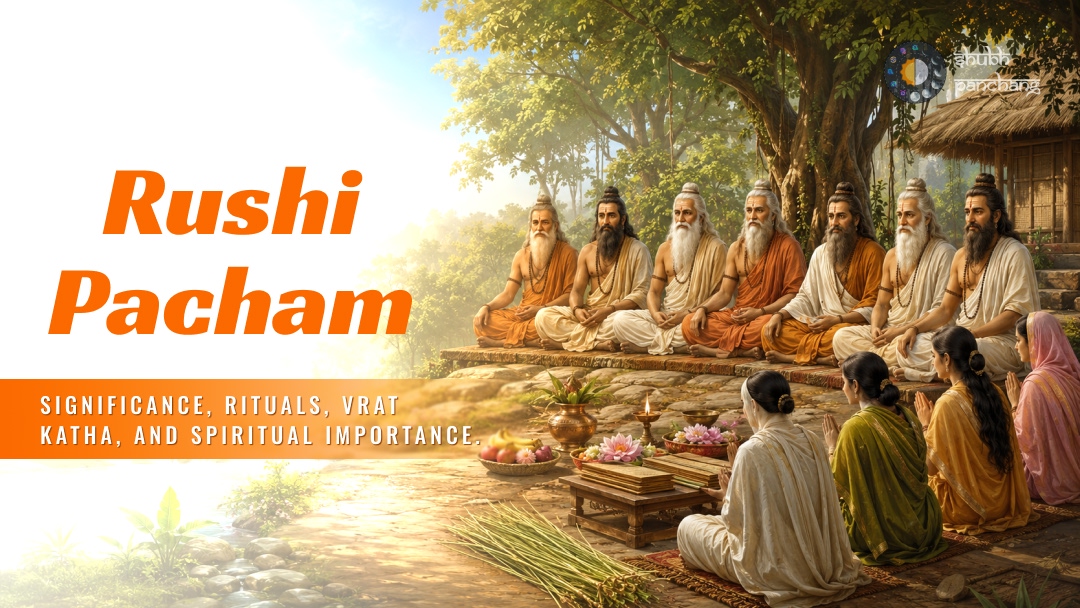
The Sapta Rishis are revered as the mind-born sons of Brahma and the eternal guardians of spiritual wisdom. During the Rishi Panchami puja, seven specific sages are invoked and worshipped as a collective group. These sages represent different facets of knowledge, penance, and societal structure. The names of the Sapta Rishis traditionally worshipped on this day are:
- Kashyapa: Known as the father of all creation.
- Atri: A sage known for his immense power of penance and contribution to the Rigveda.
- Bharadvaja: A master of economics, politics, and military science.
- Vishwamitra: The sage who gave the world the Gayatri Mantra.
- Gautama: One of the authors of the Rigveda and the discoverer of the Godavari river.
- Jamadagni: Known for his absolute mastery over the senses and father of Lord Parashurama.
- Vashistha: The royal priest of the Ikshvaku dynasty and the teacher of Lord Rama.
These sages are believed to guide the spiritual progress of the world throughout each Manvantara.
The Vrat Katha and Moral Lessons
The traditional story or Vrat Katha of Rishi Panchami emphasizes the importance of Shaucha (purity) and the consequences of ignoring spiritual discipline. One prominent narrative involves a Brahmin named Sumitra and his wife Jayashree. After their passing, due to certain lapses in following the rules of purity during their earthly life, they were reborn as a bull and a dog in their own son’s household. Their son, being a pious man, eventually learned of his parents' plight through his spiritual insight. To liberate his parents from these lower forms of birth, he and his wife observed the Rishi Panchami vrat with full devotion. This story serves as a symbolic reminder that our actions (Karma) and our adherence to discipline impact not only our present life but our spiritual continuity. It teaches that repentance through sincere prayer and austerity can mitigate the effects of past errors.
Puja Vidhi and Ritual Practices
The rituals of Rishi Panchami are centered on the theme of purification and simplicity. Devotees begin the day with a holy bath, often using Upmarga (herb) sticks for cleaning the teeth and Panchagavya for internal purification. The worship area is cleaned and a small platform is prepared, often decorated with a Sarvatobhadra Mandala. On this platform, seven betel nuts or small mounds of rice are placed to represent the Sapta Rishis, along with Arundhati (the wife of Sage Vashistha). The worship involves the Shodashopachara method—offering sixteen items including water, flowers, incense, and lamps. Specific prayers are recited to invite the sages into the altar. In many households, especially those following the tradition of Rushi pacham, the reading of the vrat katha is an essential concluding part of the ritual, followed by an aarti.
Fasting Rules and Dietary Customs
The dietary restrictions on Rishi Panchami are unique and strict compared to other Hindu fasts. One of the most significant rules is the avoidance of any food grain that is grown using bullocks or a plough. This practice is a mark of respect for the animals that assist in agriculture and a commitment to consuming only what is gathered naturally.
| Category | Permitted Food Items | Prohibited Food Items |
|---|---|---|
| Grains | Sama rice (Moraiyo/Vari), Rajgira, Singhara | Wheat, Rice (ploughed), Corn, Millets |
| Vegetables | Tubers, leafy greens from the wild | Onions, Garlic, Ploughed vegetables |
| Fats | Ghee from cow milk | Seed oils |
Devotees usually consume a single meal consisting of 'Sama' rice and specific vegetables like tuberous roots. This sattvic diet helps in maintaining the mental clarity required for meditation and prayer throughout the day.
Regional Variations in Celebration
Rishi Panchami is observed with diverse local customs across the Indian subcontinent and Nepal. In Maharashtra and Gujarat, the day is closely associated with the consumption of Rishi Panchami Sabji, a unique dish prepared using various seasonal vegetables that are not cultivated using ploughs. In Nepal, the day marks the final day of the three-day Teej festival, where women perform elaborate bathing rituals in sacred rivers like the Bagmati to seek purification. In certain parts of Rajasthan and Madhya Pradesh, the community gathers to listen to the glories of the sages, emphasizing the role of the Guru and the teacher in one's life. Regardless of the regional name, the core philosophy remains the same: a day of reflection and returning to one's spiritual roots.
Modern Relevance and Spiritual Refinement
In the modern context, Rishi Panchami serves as a day for mindful living and ecological awareness. The tradition of avoiding ploughed food reminds us of our dependence on nature and the importance of non-violence toward animals used in farming. Philosophically, the purification ritual is not merely about physical cleanliness but emotional and mental refinement. It is a day to declutter the mind of negative tendencies like ego, anger, and attachment. By remembering the Sapta Rishis, we acknowledge that human progress is built on the foundation of ancient wisdom. Modern observers often use this day to renew their commitment to learning, reading scriptures, and practicing meditation, proving that these ancient traditions remain relevant in providing a moral compass for contemporary life.