



Timekeeping in Hindu Tradition and Daily Panchang
In the Vedic tradition, time is not merely a linear progression but a cyclical force governed by planetary influences that dictate the quality of every moment. Many people consult accurate Panchang data to determine whether a specific time is 'Shubh' (auspicious) or 'Ashubh' (inauspicious) before initiating important activities such as travel, business ventures, or religious ceremonies. Central to this system are three specific daily time intervals known as Rahu Kaal, Gulika Kaal, and Yamaganda. Unlike fixed planetary hours, these periods are calculated daily based on the local sunrise and sunset timings using the दृक् गणित (Drik Ganit) method. According to the Muhurta Chintamani, selecting the right time to act ensures that the energy of the day supports the endeavor, rather than creating unnecessary obstacles. Understanding these periods allows individuals to navigate their daily schedules with greater mindfulness and alignment with traditional wisdom.
Rahu Kaal: The Period of the Shadow Planet
Rahu Kaal refers to a specific window of time each day that is considered inauspicious because it is ruled by the shadow planet Rahu. In Hindu mythology and astronomy, Rahu is associated with chaos, confusion, and material obsession, which is why work started during this time often encounters delays or unexpected complications. It is traditionally recommended to avoid starting new projects, signing contracts, performing housewarming ceremonies, or conducting marriage rituals during this period. However, it is important to clarify that regular daily chores or activities already in progress do not need to be stopped; Rahu Kaal primarily affects the 'initiation' of significant new ventures. For those following strict astrological guidelines, this period is often used for spiritual reflection or routine tasks rather than high-stakes decision-making. The duration of Rahu Kaal is approximately 90 minutes, though it varies slightly depending on the season and geographical location.
Gulika Kaal: The Influence of Gulika
Gulika Kaal is associated with Gulika, who is traditionally regarded as the son of Shani (Saturn) in Vedic astrology. Unlike Rahu Kaal, which is universally avoided for new beginnings, the interpretation of Gulika Kaal varies by region and specific astrological tradition. In many parts of Southern India, Gulika Kaal is actually considered a period where work performed will be repeated or flourish, leading some to view it as a 'fruitful' time for certain tasks. However, in other traditions, it is treated similarly to other inauspicious segments and avoided for major life events. Activities traditionally associated with Gulika Kaal include routine tasks and repetitive actions. It is generally advised to consult the various Panchang Utilities to see how Gulika Kaal aligns with your local customs, as the impact of this period is often seen as more subtle than the more prominent Rahu Kaal.
Yamaganda: The Time of Yama
Yamaganda is a specific daily interval ruled by Yama, the deity associated with death and the finality of time. Because Yama represents the end of cycles, this period is considered highly unfavorable for starting any activity that is meant to grow, prosper, or have a long life, such as starting a business, getting married, or beginning a long journey. The common belief is that any activity started during Yamaganda will meet with failure or will not reach its intended conclusion. While Rahu Kaal is often associated with confusion and obstacles, Yamaganda is specifically associated with the 'death' or termination of the effort itself. Therefore, practitioners of Vedic astrology are particularly careful to avoid this window when scheduling important milestones. Like the other segments, Yamaganda lasts for one-eighth of the total daytime, making it roughly 90 minutes under standard twelve-hour daylight conditions.
Calculation Method: The Eight-Part Division
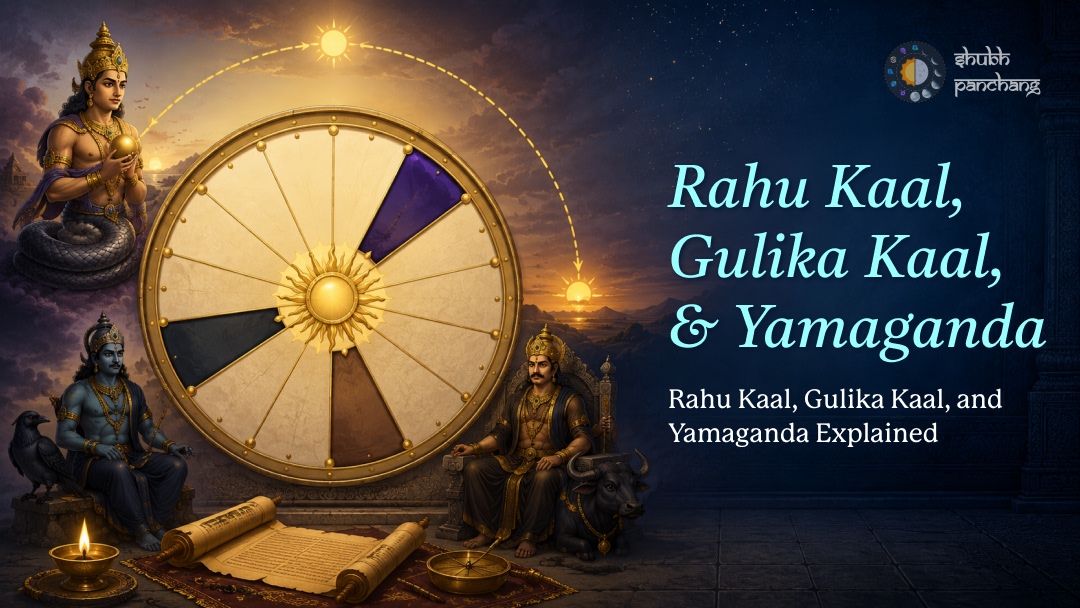
The determination of these three periods follows a systematic mathematical approach where the duration between sunrise and sunset is divided into eight equal parts called 'Chaukadiyas' or 'segments'. Since the time of sunrise and sunset changes every day and differs by city, these timings are never fixed. For example, if sunrise is at 6:00 AM and sunset is at 6:00 PM, the 12-hour day is divided into eight parts of 90 minutes each. Rahu Kaal, Gulika Kaal, and Yamaganda are assigned to specific segments based on the day of the week. This logic is rooted in the Surya Siddhanta, which emphasizes the precision of local coordinate-based calculations. Modern apps and websites simplify this by using GPS data to provide real-time updates, ensuring that users do not have to manually calculate the segments for their specific latitude and longitude.
A Quick Weekday Reference Table
To help beginners understand how these timings rotate, consider this general sequence based on an 8-part division of a standard 12-hour day (starting from sunrise). Rahu Kaal: Mon (2nd part), Tue (7th part), Wed (5th part), Thu (6th part), Fri (4th part), Sat (3rd part), Sun (8th part). Yamaganda: Mon (5th part), Tue (4th part), Wed (3rd part), Thu (2nd part), Fri (1st part), Sat (7th part), Sun (6th part). Gulika Kaal: Mon (6th part), Tue (5th part), Wed (4th part), Thu (3rd part), Fri (2nd part), Sat (1st part), Sun (7th part). Note that the 1st part of any day is never Rahu Kaal, as that time is usually reserved for morning rituals and Sandhyavandanam. This rotating schedule ensures that every day has its own unique 'rhythm' of auspicious and challenging moments.
Comparison with Abhijit Muhurat and Choghadiya
While Rahu Kaal and Yamaganda highlight moments to avoid, the Panchang also provides windows of opportunity like Abhijit Muhurat and Shubh Choghadiya. Abhijit Muhurat is a mid-day period that is considered powerful enough to overcome many negative planetary influences, including the effects of an unfavorable Rahu Kaal if an emergency arises. Choghadiya, on the other hand, is a more granular system used frequently in North India for travel and business. It is essential to distinguish these because while Rahu Kaal is a 'fixed' rule for every day of the week, Choghadiya offers shifting qualities like 'Amrit' (best) or 'Rog' (bad) throughout the day. A well-planned day involves cross-referencing these systems: avoiding Yamaganda and Rahu Kaal while aiming for a 'Shubh' or 'Labh' Choghadiya whenever possible.
Practical Guidance and Overcoming Superstition
A common misconception is that these timings should induce fear or total paralysis in daily life. Traditional wisdom intended these systems to be tools for mindfulness, not sources of anxiety. If one must travel for a life-saving medical emergency or perform an essential duty that cannot be postponed, the scriptures suggest that sincere prayer and positive intention can mitigate negative influences. These systems were historically developed to encourage people to pause, plan, and proceed with deliberate focus rather than rushing into major commitments impulsively. In the modern lifestyle, checking these timings via a digital calendar can be a grounding ritual that connects a person to the larger rhythms of nature and the movements of the planets without becoming a burden of superstition.
Modern Context and Conclusion
Integrating Rahu Kaal, Gulika Kaal, and Yamaganda into a modern lifestyle is now easier than ever through digital tools that provide instant, location-specific timings. These traditional segments of time offer a bridge between ancient astronomical observations and contemporary productivity. By respecting these intervals, many find a sense of psychological readiness and cultural grounding. Whether you are planning a wedding, launching a startup, or simply scheduling an important meeting, these timings provide a framework for choosing the path of least resistance. Ultimately, the goal of following the Panchang is to achieve a balance between practical effort and cosmic timing, ensuring that our actions are in harmony with the environment and the subtle energies of the day.