


Importance of Auspicious Timing in Hindu Traditions
Auspicious timing, known as Shubh Kaal, is the practice of selecting specific moments to align human actions with favorable celestial influences. According to Hindu tradition, starting a task at the right time enhances its success and minimizes obstacles. Before initiating significant activities such as business ventures, travel, or religious ceremonies, many consult the Panchang to identify the most suitable window. While the goal is the same—finding a favorable time—the methods used to calculate these windows differ in complexity and purpose. The three primary systems utilized in Vedic timekeeping are Choghadiya, Hora, and Muhurat, each serving a unique role in daily life.
Defining Muhurat, Choghadiya, and Hora
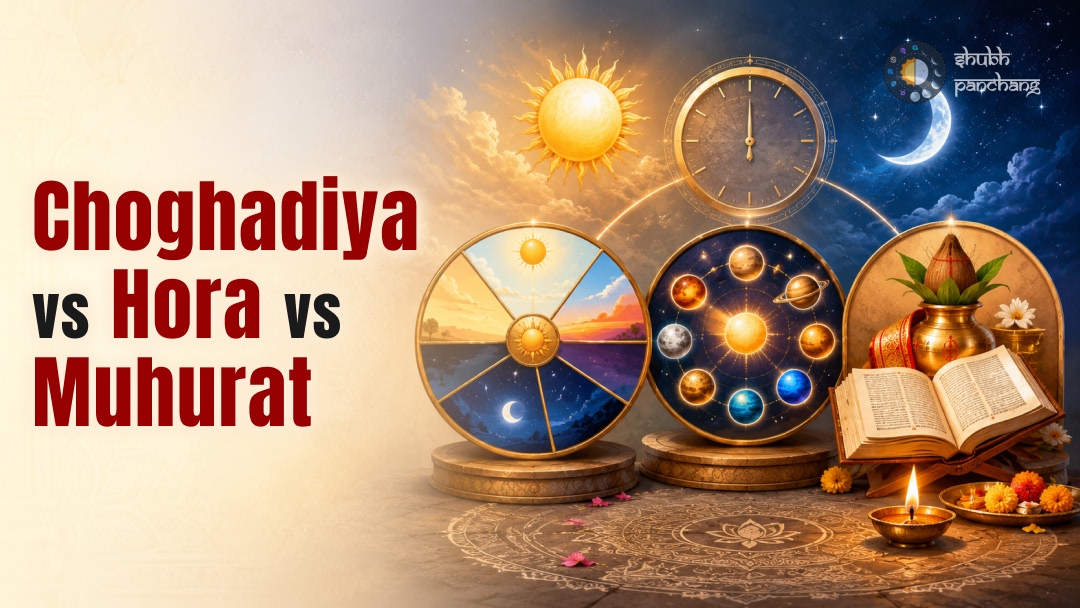
Muhurat, Choghadiya, and Hora are distinct systems of time measurement used to identify auspicious and inauspicious periods within a day. A Muhurat is a comprehensive calculation based on multiple astrological factors, including Tithi, Nakshatra, and planetary alignments, often used for major life events. In contrast, Choghadiya is a simpler system that divides the day and night into segments for quick daily decisions, especially popular in North and West India. Hora is a system based on the ruling planet of each hour, primarily used to align specific tasks with the energy of a particular deity or planet. While all three relate to timing, their calculation methods and depth of analysis vary significantly.
Understanding Choghadiya: The Eight Divisions
Choghadiya refers to a time division system where the day and night are each split into eight equal segments, roughly lasting 90 minutes each. The term is derived from 'Chau' (four) and 'Ghari' (a traditional unit of 24 minutes), as each period originally spanned four Gharis. According to traditional practices, the seven types of Choghadiya are Amrit, Shubh, Labh, Char, Rog, Kaal, and Udveg. Amrit, Shubh, and Labh are considered highly auspicious for starting any work, while Char is neutral or good for travel. Conversely, Rog, Kaal, and Udveg are generally avoided as they are associated with obstacles, illness, or anxiety. This system is heavily relied upon for choosing travel times or opening shops, particularly in Gujarati and North Indian business communities.
The Planetary Influence of Hora
Hora is a system where each hour of the day is ruled by one of the seven visible planets: Sun, Moon, Mars, Mercury, Jupiter, Venus, and Saturn. The first Hora of any day starts at local sunrise and is ruled by the planet associated with that weekday; for example, the first Hora on a Sunday is the Sun's Hora. Each planet's Hora is suitable for different activities based on that planet's nature. Jupiter's Hora is excellent for financial matters and education, Venus's Hora is favorable for arts and marriage discussions, and Mercury's Hora is ideal for communication and business. Consulting the Hora chart helps individuals choose specific hours for mundane tasks without needing a full astrological reading.
Shubh Muhurat: The Comprehensive Vedic Calculation
A Shubh Muhurat is the most sophisticated and accurate form of auspicious timing, requiring the synchronization of several astrological elements. Calculating a Muhurat involves analyzing the five limbs of the calendar (Panchang): Vara (weekday), Tithi (lunar day), Nakshatra (lunar mansion), Yoga, and Karana. Additionally, the positions of the Sun, Moon, and Jupiter must be favorable for the specific person involved. This system is primarily reserved for non-recurring, major events such as weddings (Vivah), housewarmings (Griha Pravesh), naming ceremonies (Namkaran), and major business inaugurations. Unlike Choghadiya, which is general, a Muhurat is often personalized to the individual's birth chart for maximum efficacy.
Comparing Choghadiya, Hora, and Muhurat
The primary differences between these systems lie in their complexity and intended application. Choghadiya is a simplified tool for daily use, while Muhurat is a detailed astrological prescription.
| Feature | Choghadiya | Hora | Muhurat |
|---|---|---|---|
| Complexity | Low - based on fixed divisions | Medium - based on planetary hours | High - requires full Panchang analysis |
| Best For | Travel, daily tasks, quick starts | Specific tasks (e.g., study, finance) | Weddings, property, life milestones |
| Accuracy | General / Approximate | Planetary specific | Highly Precise |
| Regional Popularity | North and West India | Pan-India / Astrology-based | Global Hindu Tradition |
While Choghadiya provides a quick 'good or bad' window, the Muhurat system ensures that every cosmic factor aligns with the specific objective of the ritual.
Choosing the Right System for Your Activity
Selecting the right timing system depends on the nature and importance of the activity you are planning. For quick daily decisions, such as when to leave for a short trip or when to purchase household items, Choghadiya is the most practical choice. If you are scheduling a specific activity like a job interview or a medical consultation, the Hora of Mercury or Jupiter might be more appropriate. For life-altering ceremonies such as a wedding or starting the construction of a house, a comprehensive Shubh Muhurat is essential. Practitioners often combine these systems by first finding a good day via Muhurat and then refining the exact hour using Hora or Choghadiya to avoid inauspicious periods like Rahu Kaal.
Modern Access and Ethical Perspective
Modern technology has made accessing traditional timing systems easier through digital platforms and mobile applications. While these tools provide instant data for Choghadiya and Hora based on local sunrise and sunset, it is important to remember that auspicious timing is a supportive guide, not a guarantee of results. Tradition emphasizes that Karma (action), Purushartha (effort), and Niyat (intention) are equally vital. Timing serves to remove subtle obstacles and provide mental confidence, but it does not replace the need for hard work and ethical conduct. Today, millions of people continue to use these systems to align their modern lifestyles with the ancient rhythms of the Vedic calendar, fostering a sense of mindfulness in their daily routines.