






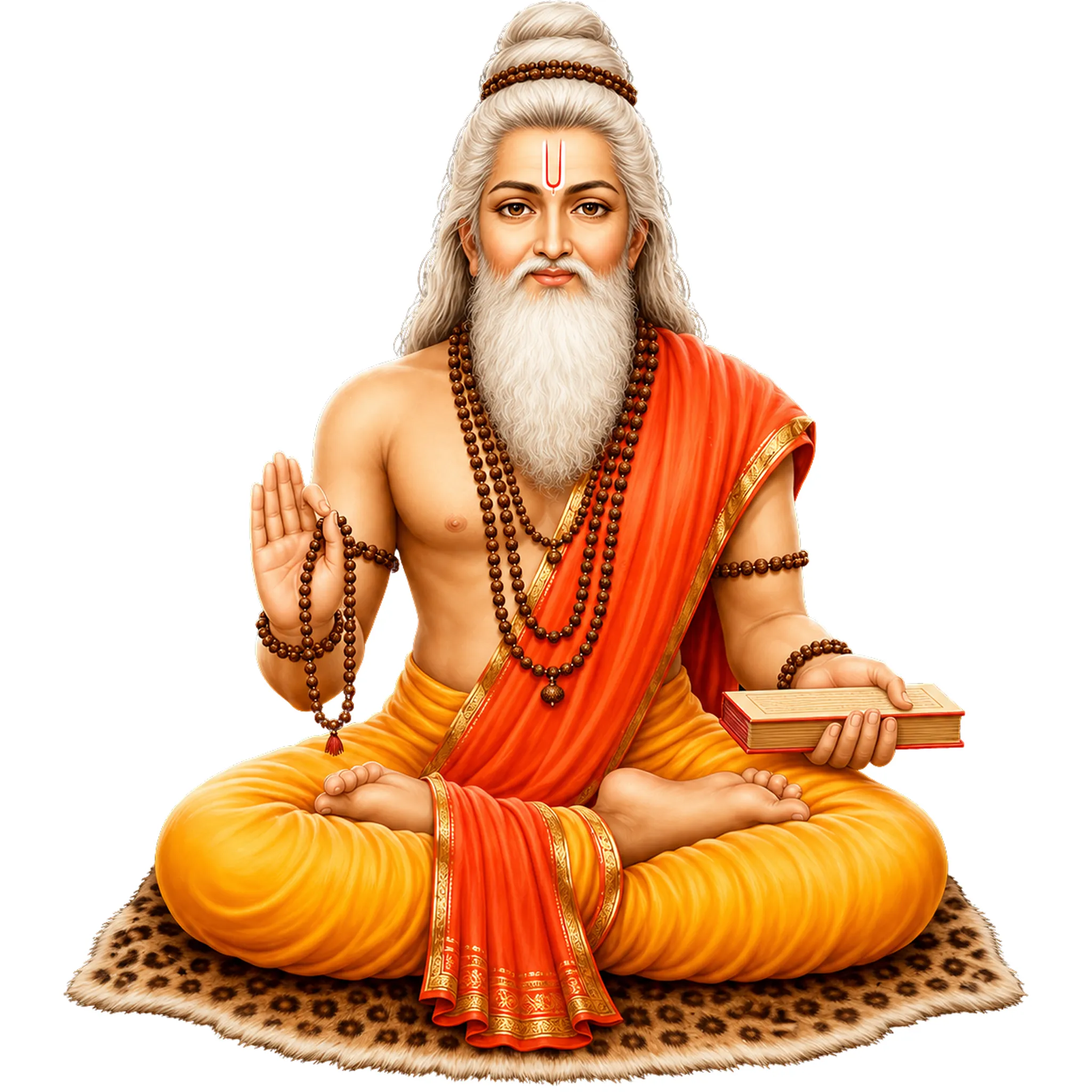
Introduction to Maharshi Veda Vyas
In Hindu scriptures, Maharshi Veda Vyas is revered as a great sage, ascetic and an inexhaustible source of knowledge. According to the Shrimad Bhagavata Mahapurana, Lord Vishnu himself incarnated as Maharshi Krishnadvaipayana Veda Vyas. He divided the Vedas and made spiritual knowledge simple and systematic for mankind. Due to this, he became famous all over the world as “Veda Vyas”.
Maharshi Veda Vyas composed many sacred texts like Mahabharata, Brahma Sutra, Eighteen Puranas and Shrimad Bhagavata. His contribution in preserving Hindu culture and Vedic tradition is considered unique. Mahabharata is also known as the “Pancham Veda”, which is a symbol of Maharshi Veda Vyas’ great scholarship.
Origin of Maharshi Ved Vyas
A special description of the birth of Maharshi Ved Vyas is found in the Adi Parva of the Mahabharata. His father was Maharshi Parashara and mother was Satyavati. Satyavati was also known as Matsyagandha, because her body smelled like fish. She used to row a boat in the Yamuna river on the orders of her father.
One day, Maharshi Parashara sat in Satyavati's boat to cross the Yamuna. Pleased with Satyavati's divine beauty, Maharshi Parashara granted her a special boon. With his blessings, a divine fragrance started spreading from Satyavati's body and she became famous as Yojanagandha. After that, Satyavati gave birth to a brilliant son on an island in the Yamuna, who later became known as Maharshi Ved Vyas.
Since he was born on an island, he was called “Dvaipayana” and because of his dark complexion, he was famous as “Krishna Dvaipayana”. From his childhood, he was immersed in extraordinary knowledge and penance.
Veda Vyasa as the divider of the Vedas
In ancient times, the Vedas were extremely vast and complex, which were difficult for the common people to understand. Maharishi Veda Vyasa divided the Vedas into four main parts for the welfare of mankind Rigveda, Yajurveda, Samaveda and Atharvaveda.
He imparted the knowledge of all these four Vedas to his disciples. He taught the Rigveda to Payal, the Yajurveda to Vaishampayan, the Samaveda to Jaimini and the Atharvaveda to Sumantu. Through this work, Maharishi Ved Vyas spread Vedic knowledge to the entire society.
Composition of Mahabharata and Puranas
Maharshi Ved Vyas composed the Mahabharata and explained the philosophy of religion, justice and life in simple language. The Mahabharata includes a divine river of knowledge like the Bhagavad Gita, which is considered a spiritual guide all over the world.
He composed eighteen Puranas, compiling devotion, yoga, religion and history. The Shrimad Bhagavat Maha Purana is considered the supreme scripture of the path of devotion, the knowledge of which was also given by Maharishi Ved Vyas himself.
Maharshi Ved Vyas's contribution to the Kuru dynasty
Maharshi Ved Vyas's relationship is also closely linked to the Kuru dynasty. After Satyavati's marriage to King Shantanu, a crisis arose in the Kuru dynasty. Since Satyavati's son Vichitravirya had no children, Maharishi Veda Vyas gave birth to Dhritarashtra, Pandu and Vidura according to the Niyoga tradition to continue the dynasty.
Thus Maharishi Veda Vyas became the father of the main characters of the Mahabharata and an important guide to the Kuru dynasty. His entire life was dedicated to the welfare of religion and society.
Description of the form of Maharishi Veda Vyas
Maharishi Veda Vyas is usually depicted as an old sage. He is depicted in saffron clothes, a long white beard and a mane of hair. He is adorned with a tilak on his head and a rudraksha garland around his neck.
In many paintings, he is shown writing the Vedas or the Mahabharata. In his hands is seen a granth, kamandal or rosary, which is a symbol of knowledge and penance.
Family of Maharshi Vedvyasa
Maharshi Vedvyasa's father was Maharshi Parashara and mother was Satyavati. Bhishma, Chitrangada and Vichitravirya are considered to be his adopted brothers.
His wife was Aruni, also known as Vatika and Pinjala. Maharshi Shukadeva was their son, who gave the divine knowledge of Shrimad Bhagavatam to King Parikshit.
Mantra of Maharshi Vedvyasa
॥ ॐ वेदव्यासय नमः ॥
॥ व्यासाय विष्णुरूपाय व्यासरूपाय विष्णुवे॥ नमो वै ब्रह्मानिधाय वसिष्ठाय नमो नमः ॥
॥ नमोस्तु ते व्यास विशालबुद्धे फुल्लरविन्दायतपत्रनेत्र॥
Festivals associated with Maharshi Vedvyas
Vyasa Purnima, also known as Guru Purnima, is an important day dedicated to Maharshi Vedvyas. On this day, disciples worship their gurus and remember Maharshi Vedvyas as the original Guru of knowledge.
Guru Purnima holds a special place in the Indian spiritual tradition and the contributions of Veda Vyasji are commemorated on this day.
Famous pilgrimage sites of Maharshi Vedvyas
There are many holy places associated with Maharshi Vedvyas in India. The Vyas Gaddi in Sitapur, Uttar Pradesh, and the Vyas Tapasthal in Mathura are very famous.
There are also temples and ashrams of Maharishi Ved Vyas in Rajasthan, Uttarakhand, and Odisha, where devotees come for darshan and sadhana.
Spiritual significance of Maharshi Ved Vyas
Maharshi Ved Vyas is respected as a great sage and writer of Hinduism. He showed mankind the path of religion and spirituality through invaluable texts like the Vedas, Puranas, and Mahabharata.
His life is a symbol of devotion, knowledge, and penance. Even today, millions of people get inspiration for life from his teachings and texts.