






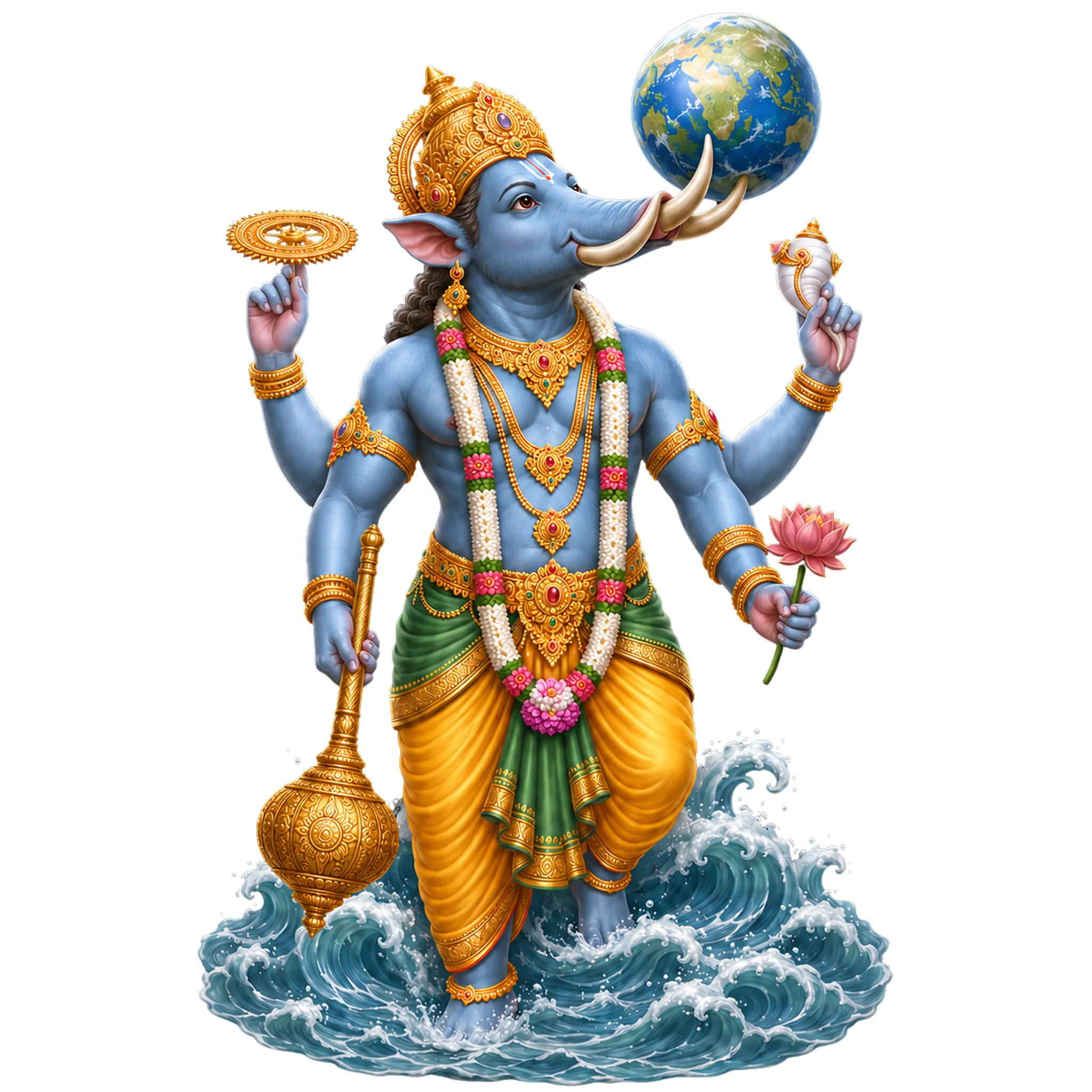
Introduction to Lord Varaha
Lord Varaha is known as the third avatar in the sacred ten avatars of Lord Vishnu. The word “Varaha” means boar or wild boar. Lord Vishnu assumed the divine form of a boar to protect religion and the earth, due to which this avatar became famous as “Varaha Avatar”.
In Hinduism, Lord Varaha is considered a symbol of power, protection and establishment of religion. The third day of the Shukla Paksha of the month of Bhadarva is celebrated as Varaha Jayanti. On this day, devotees perform special worship and devotion to Lord Varaha.
Importance of Lord Varaha Avatar
Varaha Avatar is considered one of the most powerful and mysterious avatars of Lord Vishnu. According to mythological stories, when the earth was submerged in water due to the influence of unrighteous and demonic forces, Lord Vishnu saved the earth by assuming the form of Varaha.
Lord Varaha not only protected the earth, but also re-established religion and truth. This incarnation shows that God can assume any form to protect his devotees and the creation.
Mythological story of Varaha Avatar
Many forms and stories of Lord Varaha are described in religious texts. Forms like Nil Varaha, Adi Varaha and Shveta Varaha are particularly well-known. According to mythological beliefs, once due to a terrible flood, the entire creation was submerged in water.
At that time, Lord Brahma meditated on Lord Vishnu and prayed for the protection of the creation. Lord Vishnu took the form of a blue boar, pulled the earth out of the water and made it stable again. With this act of Lord Varaha, life and greenery began again in the entire creation.
The story of Jaya-Vijaya and Hiranyaksha
It is narrated in the scriptures that Lord Vishnu's gatekeepers Jaya and Vijaya were cursed by the Sanakadi sages, due to which they were born in the womb of a demon. After that, they were born as Hiranyaksha and Hiranyakashipu.
Hiranyaksha was an extremely powerful and arrogant demon. He took the earth to the abyss and spread fear and unrest in the entire creation. Then Lord Vishnu took the form of Varaha and killed Hiranyaksha and held the earth in his tusks and stabilized it again.
Battle of Lord Varaha and Hiranyaksha
A fierce battle took place between Lord Varaha and Hiranyaksha. Hiranyaksha challenged Lord Varaha to a battle and a fierce battle continued between the two for many years.
Finally, Lord Varaha killed Hiranyaksha with his divine prowess. This victory is considered a symbol of the victory of religion over unrighteousness. After the battle was over, the gods showered flowers on Lord Varaha and praised him.
Description of Lord Varaha's form
Lord Varaha's form is depicted as half human and half boar. His face is that of a boar and his body is human. Lord Varaha is usually depicted in a blue-coloured form.
He holds a conch, a disc, a mace and a lotus in his four arms. In many paintings, Lord Varaha is depicted holding the earth in his teeth. In some forms, Bhoomi Devi is also depicted sitting on his thigh.
Family of Lord Varaha
Bhoomi Devi is described in religious texts as the wife of Lord Varaha. In the blue-coloured Varaha form, his half-brother is considered to be Nayana Devi.
According to some mythological accounts, Lord Varaha emerged from the nostrils of Lord Brahma, due to which Lord Brahma is also considered to be his father.
Mantras of Lord Varaha
Chanting the mantras of Lord Varaha provides protection, strength and stability in life. Devotees pray for freedom from negative energies and spiritual progress through the worship of Lord Varaha.
॥ ॐ वराहाय नमह ॥
ॐ ओम�ृतसूकरूरपेकेशवाय ॥
ॐ ओम धृतसूकरूरपेशवाय ॥
ॐ ओम धनुरधराय विद्यमे वक्रदंष्तराय धीमहि तनौ वराहाहिह ॥
Festivals associated with Lord Varaha
Varaha Jayanti is celebrated on the third day of the bright fort
Varaha Dwadashi is also a special day dedicated to Lord Varaha. On this occasion, devotees observe fast and worship the boar form of Lord Vishnu.
Famous Temples of Lord Varaha
There are many famous temples of Lord Varaha in India. Among them, Khajuraho Varaha Temple in Madhya Pradesh, Pushkar Varaha Temple in Rajasthan and Shri Varaha Swamy Temple in Andhra Pradesh are particularly famous.
There are ancient temples of Lord Varaha in many places including Vrindavan, Karnataka, Bihar and Gujarat, where thousands of devotees come for darshan every year.
Spiritual Significance of Lord Varaha
Lord Varaha is a symbol of religion, protection and truth. His story teaches the devotees that God always takes incarnations to protect his devotees and the creation.
Worship of Lord Varaha develops courage, confidence and spiritual strength in the mind. He inspires the devotees to remain patient and positive in difficult times.