






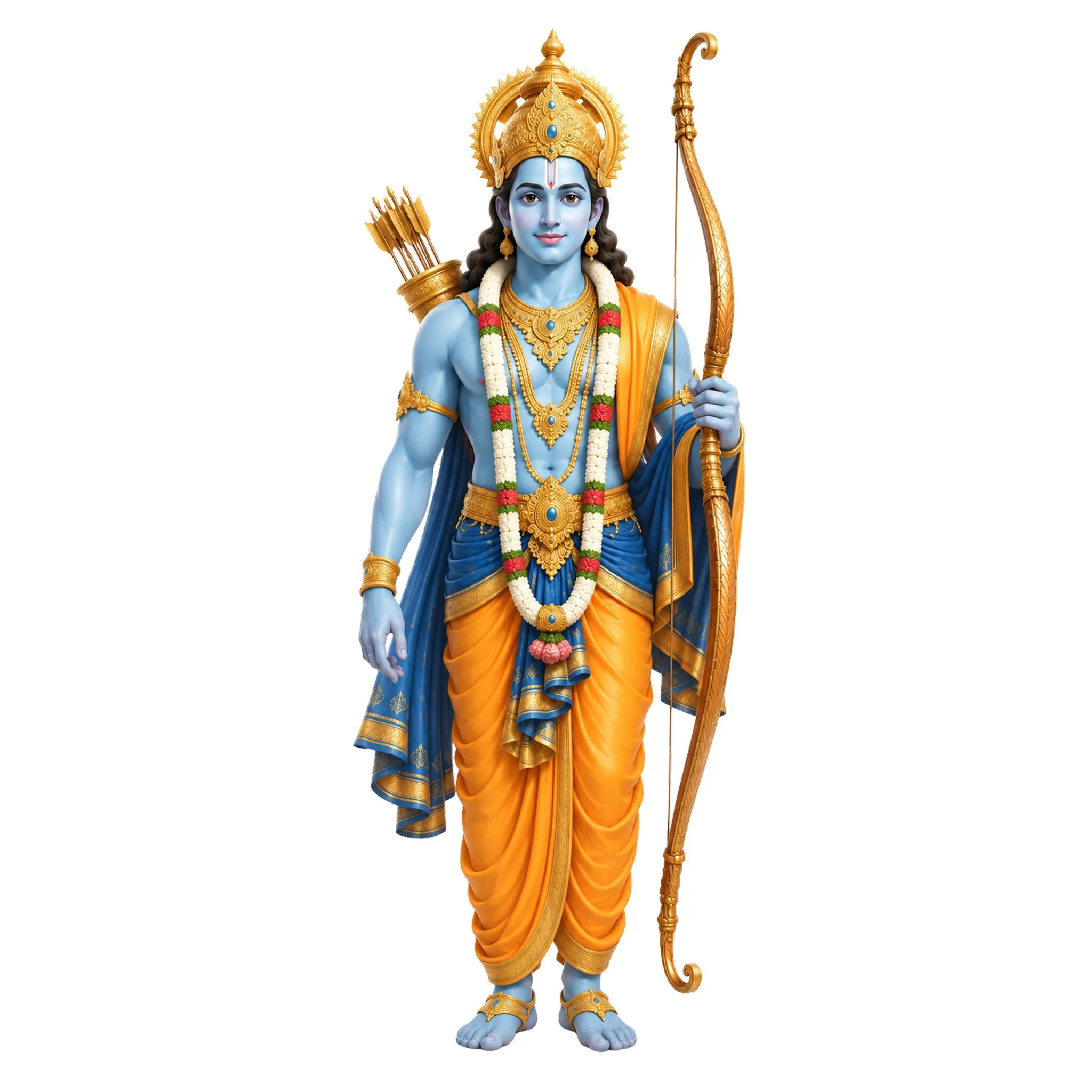
Introduction to Lord Shri Ram
Lord Shri Ram is one of the most revered and ideal deities of Hinduism. He is considered to be the seventh incarnation of Lord Vishnu. Lord Shri Ram incarnated in Treta Yuga to establish religion, protect truth and destroy the wicked. Due to his ideal life, sincerity and piety, he is famous as “Maryada Purushottam”.
Birth of Lord Shri Ram
In Treta Yuga, King Maharaja Dasharatha of Ayodhya performed Ashvamedha and Putrakameshti yagnas under the guidance of sage Rishi Rishi to get children. During the yagna, the deity who appeared from the divine fire offered holy kheer to King Dasharatha and asked him to distribute it among his queens.
Mother Kaushalya took half of the kheer, mother Kaikeyi took one part and mother Sumitra took the kheer twice. As a result, Lord Shriram was born from Kaushalya's womb, Bharat from Kaikeyi and Lakshman and Shatrughan from Sumitra.
Childhood and Family of Lord Shriram
Lord Shriram was the eldest son of Maharaj Dasharatha. His mother's name was Kaushalya. Bharat, Lakshman and Shatrughan were his brothers. Lord Shriram's sister's name was Shanta. Lord Shriram was married to Devi Sitaji, the daughter of King Janak.
Lord Shriram and mother Sita had two sons named Lav and Kush. Lav and Kush were born in the ashram of Rishi Valmiki.
Exile and the Killing of Ravana
Despite being the heir to the throne of Ayodhya, Lord Shriram was exiled for 14 years due to fulfilling the promise of his father Dasharatha. Along with Lord Shriram, Mother Sitaji and brother Lakshman also went to the forest.
During the exile, the king of Lanka, Ravana, had abducted Mother Sita by cheating. Then Lord Shriram, with the help of the monkey army and Lord Hanuman, killed Ravana and established the victory of truth and religion. This day is still celebrated as Dussehra or Vijayadashami.
Return to Ayodhya and Deepavali
After 14 years of exile, Lord Shriram returned to Ayodhya and was crowned. In celebration of Lord Shriram's arrival in Ayodhya, lamps were lit throughout Ayodhya. The festival of Deepavali is celebrated every year to commemorate this event.
Description of Lord Shri Ram
Lord Shri Ram is usually depicted in a dark or blue complexion. He is depicted in a two-armed form, holding a bow called Kodanda and arrows in his hands. He wears a quiver full of arrows on his shoulder and he wears a pitambar.
In some paintings, Lord Shri Ram is also depicted in a four-armed form, in which he holds a wheel, lotus, bow and arrows.
Mantras of Lord Shri Ram
Chanting the mantras of Lord Shri Ram brings peace, devotion and positive energy in the mind.
॥ Om Shri Ramachandraya Namah ॥
॥ Om Raam Ramaya Namah ॥
॥ Shri Ram Jai Ram Jai Jai Ram ॥
॥ Om Dasharathaye Vidyamhe Sitavallabhai Dhimahi Tanno Ramah Prachodayat ॥
Festivals associated with Lord Shri Ram
The main festivals associated with Lord Shri Ram include Ram Navami, Deepavali and Dussehra. Ram Navami is celebrated as the birth anniversary of Lord Shri Ram, while Dussehra is celebrated as a symbol of Lord Shri Ram's victory over Ravana.
Famous Temples of Lord Shri Ram
There are many famous temples of Lord Shri Ram in India. Among them, the Shri Ramlala Temple of Ayodhya, Hariharnath Temple (Bihar), Shri Ram Tirtha Temple (Punjab), Shri Ramraja Temple (Orchha), Kalaram Temple (Nasik) and Sitaramchandraswamy Temple (Bhadrachalam) are particularly famous.
Importance of Lord Shri Ram
Lord Shri Ram is considered the symbol of an ideal son, ideal brother, ideal husband and ideal king. His rule is known as “Ramrajya”, which is a symbol of justice, truth and happiness and prosperity. Devotion to Lord Shri Ram inspires one to follow the path of righteousness, peace and religion in life.