






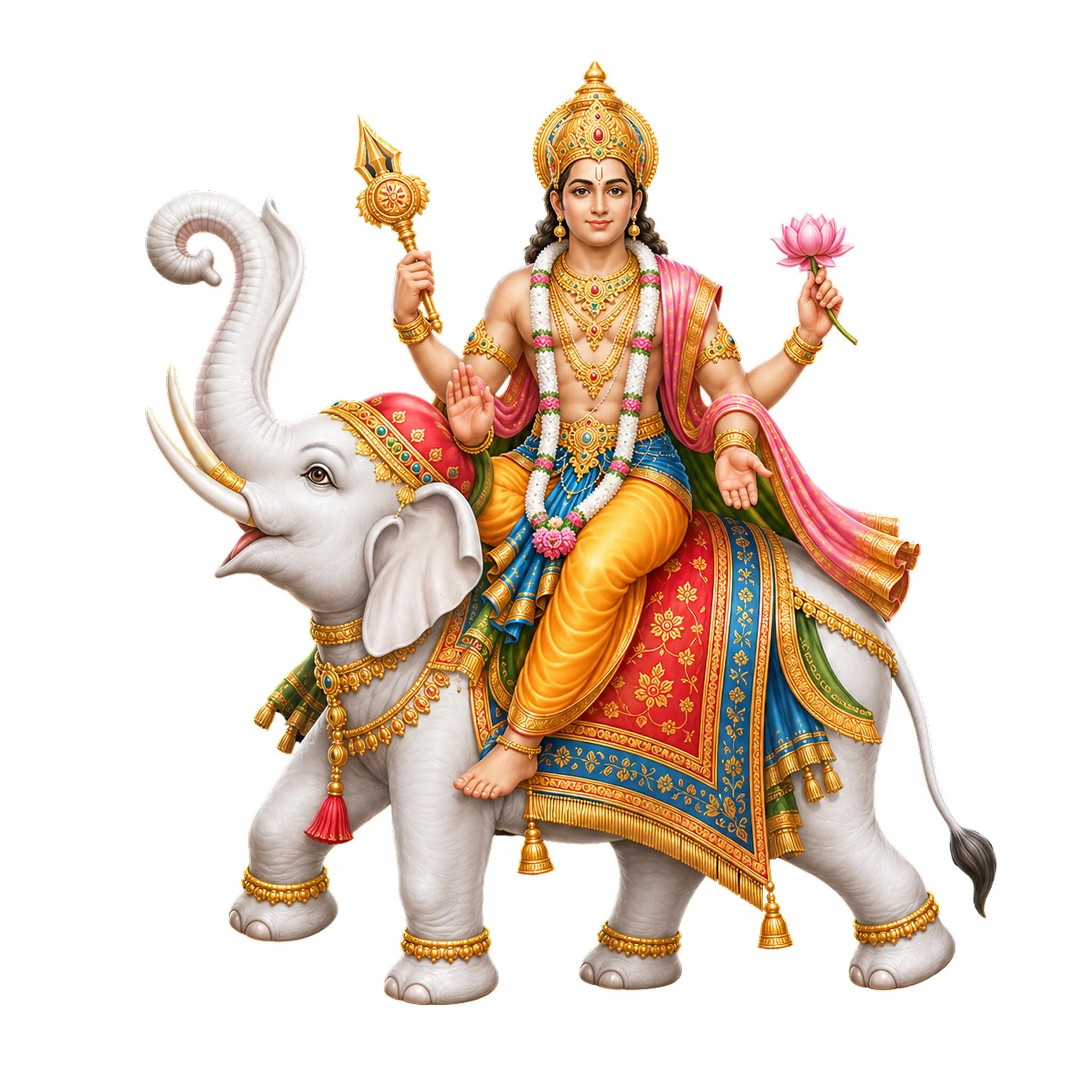
Introduction to Lord Indra
Lord Indra is one of the ancient and powerful gods of Hinduism. He is known as the king of gods and the god of rain. Lord Indra has been given a special place in Vedic scriptures and a wide description of his glory is found especially in the Rigveda.
The god Indra is considered the ruler of heaven. He is famous by names like “Indra”, “Devaraj”, “Shakra” and “Purandar”. According to Hindu beliefs, Indra is not a single person but a symbol of the highest position in heaven.
Importance of Lord Indra
Lord Indra is considered the god of rain, lightning, power and victory. Since rain has special importance in agriculture, nature and the life cycle, the worship of Indra was very popular in the Vedic age.
He is known as the protector of devotees and the leader of the gods against the demons. As the thunderbolt-wielding god, Lord Indra is considered a symbol of strength, courage and leadership.
Origin of Lord Indra
There are many stories about the origin of Lord Indra in religious texts. According to some versions of the Rigveda, he is considered the son of Devamata Aditi and Maharishi Kashyapa.
According to Hindu beliefs, a person who completes 100 Ashvamedha yagnas attains the status of Indra. There is a different Indra in each Manvantar and in the present time, Indra named Purandar rules the heavens.
Wars with the King of Devas Indra and the Asuras
Lord Indra protected the gods and religion by killing Vritrasur, Namuchi, Shambar and many other Asuras. He is known as the leader of the Devasena.
In the Vedic stories, Lord Indra is described as the friend and protector of his devotees. His prowess in the wars against the Asuras is specially described.
Amaravati and Indraloka
Lord Indra resides in Amaravati, the capital of Svargaloka. It is described that there are Nandanavan, Kalpavriksha, Parijat and divine fragrant trees there.
His royal assembly is called “Indrasabha” and his throne is called “Indrasana”. Indraloka is considered a symbol of splendor, happiness and divine bliss.
Description of Lord Indra
In the Vedic texts, Lord Indra is depicted in a huge and radiant form. In some descriptions, he is also known as “Harishma Shru” with a green beard and moustache.
In many paintings, Lord Indra is depicted with thousands of eyes. He holds a divine weapon called Vajra in his hand, which is the main symbol of his power.
Eravata and Ucchaishrava
Lord Indra's vehicle is a divine white elephant named Eravata, which was obtained from the churning of the ocean. His divine horse is named Ucchaishrava.
The Airavata elephant is considered a symbol of the kingship and splendor of Lord Indra.
Family of Lord Indra
According to mythological beliefs, the name of Lord Indra's wife is Shachi, who is also known as Indrani. Their son's name is Jayanta.
The gods Agni and Pushan are considered the brothers of Lord Indra.
Mantras of Lord Indra
Chanting the mantras of Lord Indra gives strength, confidence and success.
॥ ॐ इंद्राय नमह ॥
॥ ॐ सहस्रनेत्राय विद्यमे भेजरहसत्यमे धीमहि तनो इंद्रायहस्ता �्यमे त्�
Festivals associated with Lord Indra
Indra Jatra, Yenya Purnima and Indrotsav are the main festivals associated with Lord Indra. These festivals are celebrated in a grand manner, especially in Nepal and some regions of India.
Famous Temples of Lord Indra
There are some famous temples dedicated to Lord Indra in India. Among them, Indal Dev Temple (Chhattisgarh), Indrali Temple (Karnataka), Indreshwar Temple (Indore) and Sureshwari Devi Temple (Haridwar) are particularly famous.
Spiritual Significance of Lord Indra
Lord Indra is considered the god of power, leadership and balance of nature. Due to his close association with rain and agriculture, he had a very important place in the culture of ancient India.
By worshipping Lord Indra, devotees gain courage, victory and positive energy.