


The Role of Panchang in Daily Hindu Life
Panchang is the foundational system of Hindu timekeeping used to synchronize daily activities with the movement of celestial bodies. The word itself translates to five limbs, representing Tithi (lunar day), Vara (weekday), Nakshatra (lunar mansion), Yoga (luni-solar period), and Karana (half of a tithi). Traditionally, a Panchang is essential for determining the timing of festivals, observing vrats (fasts), and identifying Shubh Muhurats for events such as weddings, housewarmings, or business ventures. For generations, this wisdom was contained within printed almanacs, but today, modern technology has introduced digital platforms that calculate these elements with algorithmic precision. Understanding the difference between these two mediums is crucial for anyone looking to integrate Shubh panchang into their daily routine without compromising on scriptural accuracy.
The Legacy of Printed Panchangs and Regional Almanacs
Traditional printed calendars have served as the primary spiritual guide in Indian households and temples for centuries. These almanacs, often based on specific regional traditions like the Vikram Samvat or Shaka Samvat, are deeply embedded in family rituals and are frequently kept in home mandirs. Families often consult a specific publisher’s calendar based on their ancestral lineage or region, such as the Gujarati, Tamil, or Bengali systems. According to texts like the Nirnaya Sindhu and Dharmasindhu, the observance of rituals depends heavily on the local customs of the community. The printed format provides a tangible connection to these traditions, often featuring local festival lists and deities specific to a geographical area, which fosters a sense of cultural continuity that many older generations still find indispensable.
The Rise of Digital Panchang Platforms
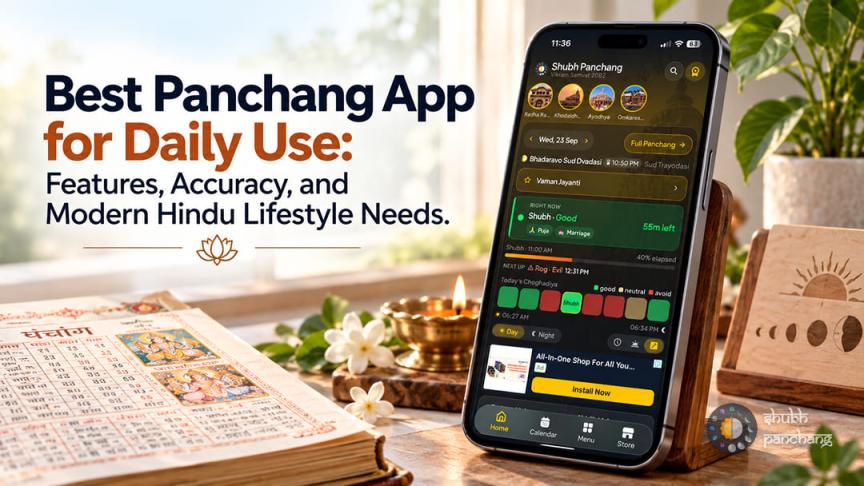
Modern lifestyle demands have led to the rapid adoption of digital Panchang applications and websites which offer instantaneous access to complex calculations. Unlike printed versions that require manual decoding of tables, digital tools automate the process, providing real-time data for Rahu Kaal, Choghadiya, and Gulika Kaal at the touch of a button. These platforms often use modern astronomical data combined with ancient formulas to provide high-resolution timing. The primary driver for this shift is portability; a digital tool allows a devotee to check an auspicious time or a tithi regardless of their location, whether they are traveling or at their workplace. This accessibility ensures that Vedic timekeeping remains relevant for the younger generation who may find traditional paper almanacs difficult to read or interpret.
Digital vs Printed Panchang Comparison
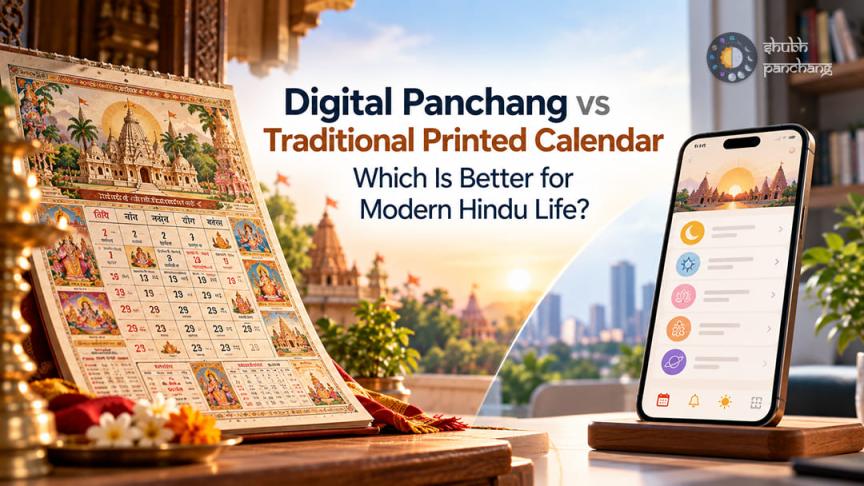
Deciding between digital and printed versions often comes down to a choice between speed and sentiment. While both aim to provide the same core data, their execution differs significantly.
| Feature | Traditional Printed Calendar | Digital Panchang App |
|---|---|---|
| Accessibility | Stationary (usually at home) | Mobile (accessible anywhere) |
| Calculations | Fixed for a specific city | Dynamic and location-based |
| Notifications | Manual check required | Push alerts for Vrats and Tithis |
| Ease of Use | Requires learning to read tables | User-friendly intuitive interface |
| Longevity | Physical archive of the year | Requires internet or battery |
Accuracy and the Importance of Location-Based Drik Ganit
Drik Ganit (the calculation method based on observation) is the most accurate way to determine sunrise and sunset times, which are the basis for all Panchang calculations. A major limitation of traditional printed calendars is that their data is typically calculated for a specific reference city, such as Varanasi or Ujjain. If a person is using a Delhi-based printed calendar in London or New York, the tithi end times and muhurats will be significantly inaccurate. Digital systems solve this problem by using GPS coordinates to provide location-specific Drik Ganit calculations. This ensure that festivals like Karwa Chauth or Ekadashi, which depend on specific moonrise or sunrise timings, are observed at the correct local moment as prescribed by the Surya Siddhanta.
Cultural Rituals and the Spiritual Experience
The physical presence of a traditional calendar in a home mandir offers a spiritual value that a smartphone screen rarely replicates. Many devotees view the printed Panchang as a sacred object, often decorated with auspicious symbols and images of deities. It serves as a visual reminder of upcoming festivals and communal fasts, encouraging collective family participation. However, digital platforms are evolving this experience by integrating spiritual resources like stotrams, mantras, and detailed puja vidhis alongside the calendar data. While the printed calendar excels at providing a broad cultural overview, digital tools provide depth and guidance for those who may not have a priest or elder available to explain the nuances of a ritual.
Bridging the Gap for Modern Families
Most modern Hindu families find that a hybrid approach is the most effective way to manage their spiritual schedules. The printed calendar can be maintained in the kitchen or puja room for general awareness of the month's festivals, while a digital app is used for precise planning. For example, while the wall calendar might show that a certain day is auspicious, a digital tool can pinpoint the exact Choghadiya window that fits into a busy workday. This combination allows for the preservation of traditional habits while leveraging the precision of modern calculation methods. Ultimately, whether one uses a paper almanac or a mobile application, the objective remains the same: to live in harmony with the rhythms of time as defined by the Vedic sages.