







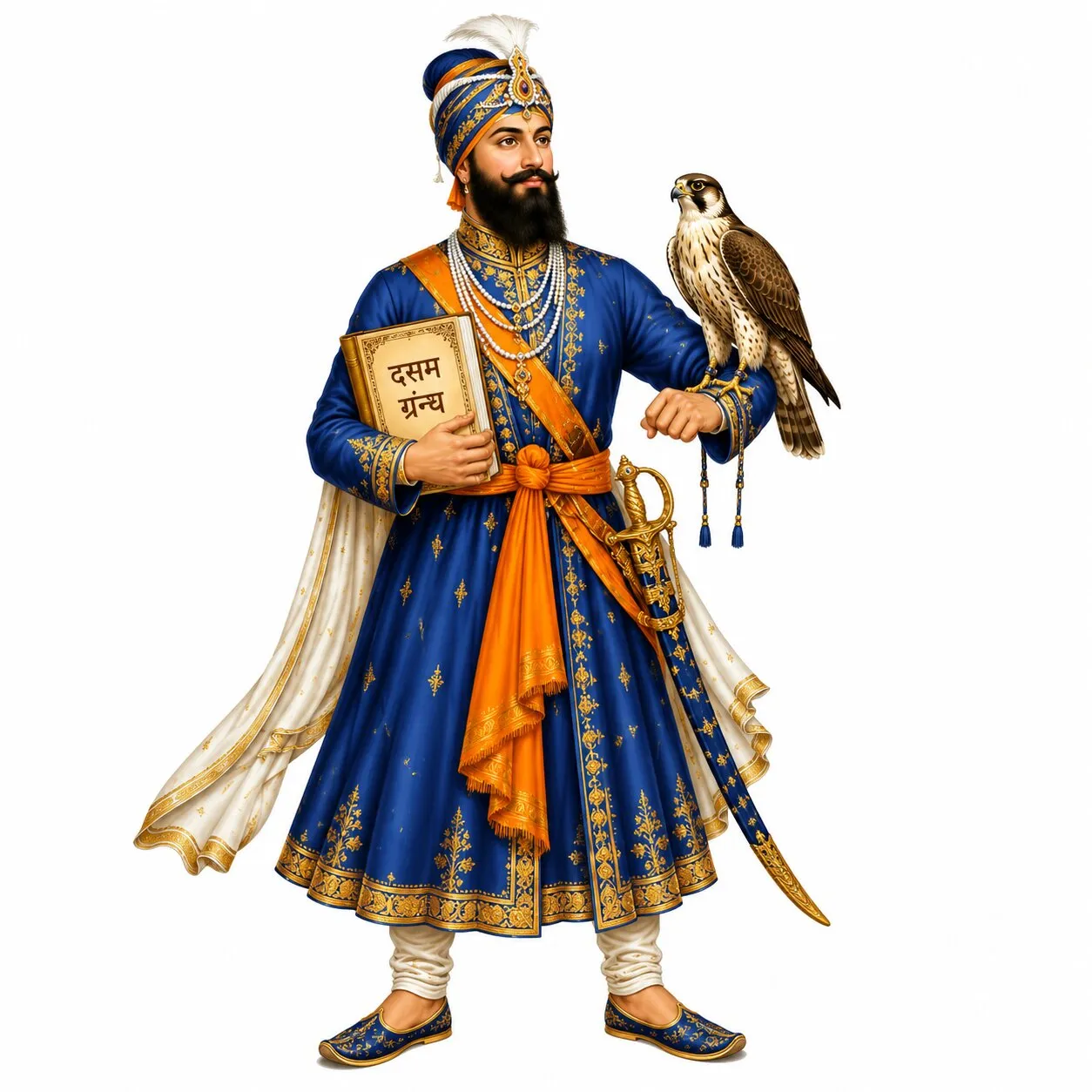
Who was Guru Gobind Singh Ji?
Guru Gobind Singh Ji was the tenth and last human Guru of Sikhism. He is remembered with respect worldwide as a great warrior, poet, spiritual master, social reformer and protector of religion. Guru Gobind Singh Ji gave a new identity, new strength and spiritual direction to the Sikh community. He founded the Khalsa Panth and inspired it to fight against injustice, tyranny and adharma. His entire life is a unique example of truth, religion, courage, sacrifice and service to humanity.
Birth and early life of Guru Gobind Singh Ji
Guru Gobind Singh Ji was born on December 22, 1666 at Patna Sahib (Bihar). His childhood name was Gobind Rai. His father, Guru Tegh Bahadur Ji, was the ninth Guru of Sikhism and his mother's name was Mata Gujri. From childhood, Guru Gobind Singh Ji was exceptionally intelligent, fearless and spiritually inclined. He studied scriptures, languages, martial arts and spiritual knowledge in depth. At a very young age, he became a guide for the Sikh community.
Guru Tegh Bahadur Ji's Sacrifice and the Responsibility of Guruship
When religious persecution was increasing during the time of the Mughal ruler Aurangzeb, Guru Tegh Bahadur Ji sacrificed himself to protect religion and human rights. After his martyrdom, Guru Gobind Singh Ji took over the responsibility of Guruship at the age of just nine. He carried forward his father's ideals and continued the struggle for religion and justice by organizing the Sikh community.
Establishment of the Khalsa Panth
On the auspicious day of Vaisakhi in 1699 CE, Guru Gobind Singh Ji founded the Khalsa Panth at Anandpur Sahib. He started the Khalsa by offering Amrit Pan to five beloved ones. The main purpose of the Khalsa Panth was to protect religion, fight for justice and serve humanity. Guru Ji gave the epithet "Singh" to the Sikhs and "Kaur" to the women, giving them the message of equality and self-respect. The Khalsa Panth is still a symbol of the identity and pride of Sikhism.
Literary and spiritual contributions of Guru Gobind Singh Ji
Guru Gobind Singh Ji was not only a warrior, but also a great poet and scholar. He composed many spiritual and inspirational compositions, which are included in the Tenth Granth. His writings embody a beautiful blend of devotion, valour, religion and moral values. He exhorted the Sikhs not only to bear arms but also to respect scripture and knowledge.
Sacrifice and Legacy of Guru Gobind Singh Ji
Guru Gobind Singh Ji faced many difficult situations in his life. All his four sons were martyred for the protection of religion and justice. However, Guru Ji never compromised with his goal. He fought for truth, justice and religion throughout his life. In his final days, he declared that henceforth Guru Granth Sahib would be the eternal Guru of the Sikhs. Through this decision, he linked spiritual leadership with scripture and principles.
Spiritual and Cultural Significance of Guru Gobind Singh Ji
Guru Gobind Singh Ji's life is a symbol of courage, sacrifice, equality and piety. He taught the society that remaining silent in the face of injustice is also a form of injustice. His teachings still inspire millions of people to follow the path of truth, fearlessness, service and humanity. His contribution to the development and protection of Sikhism is unique and unforgettable.
Conclusion
Guru Gobind Singh Ji was a great Guru, warrior and social reformer of Sikhism. He has achieved an unforgettable place in history through the establishment of the Khalsa Panth, his sacrifice for the protection of religion and the propagation of the values of humanity. His life still inspires to follow the path of truth, courage, equality and devotion. Guru Gobind Singh Ji's contribution continues to be a source of inspiration for the entire mankind.