


What is Bol Choth and Who Observes It?
Bol Choth is a traditional Hindu festival observed primarily in Gujarat and parts of Western India by married women for the health, prosperity, and longevity of their children. This festival occurs during the Krishna Paksha Chaturthi of the Shravan month, making it a significant part of the monsoon season's spiritual calendar. The day is deeply rooted in the concept of maternal devotion and the cultural reverence for cattle, specifically the cow and her calf. Unlike many other fasts, the Bol Choth vrat focuses specifically on the symbiotic relationship between humans and animals, emphasizing the nurturing qualities of the cow as a mother figure in Vedic culture.
When is Bol Choth Observed in the Hindu Calendar?
Bol Choth is observed on the fourth day of the dark fortnight in the month of Shravan according to the Amanta calendar followed in Gujarat and Maharashtra. In the Purnimanta system common in North India, this day aligns with the Bhadrapada Krishna Chaturthi. The timing of this festival is essential as it precedes the major festival of Krishna Janmashtami, highlighting the pastoral lifestyle associated with Lord Krishna. Accurate timing for the Chaturthi tithi is determined according to Drik Ganit principles, ensuring that the puja is performed during the correct Muhurat when the lunar influence is most conducive to the vrat's objectives.
The Spiritual Connection Between Motherhood and Cows
The name Bol Choth is closely associated with the worship of Bahula, a divine cow who represents the epitome of truth and maternal sacrifice. In Hindu tradition, cows are not merely livestock but are considered sacred beings that house various deities, a concept reinforced in the Bhavishya Purana and other classical texts. On this day, the cow is worshiped as Gau Mata, symbolizing selfless nourishment and protection. By honoring the cow and her calf, mothers invoke similar protective energies for their own children, acknowledging that the well-being of the family is inextricably linked to the well-being of the environment and the animals that sustain it.
The Vrat Katha: Legend of the Bahula Cow
The mythological background of Bol Choth centers on the story of the cow Bahula and a lion, which serves as a moral lesson on the power of truth and duty. According to the traditional Vrat Katha, Bahula was cornered by a lion while returning to her hungry calf. She pleaded with the lion to let her go so she could feed her calf one last time, promising to return and sacrifice herself. To the lion's surprise, Bahula returned as promised after fulfilling her motherly duty. Lord Krishna, who had taken the form of the lion to test her, was so moved by her integrity that he blessed her, declaring that she would be worshiped on this specific Chaturthi. This narrative forms the spiritual core of the festival, teaching devotees that sincerity in one's vows is the highest form of worship.
Essential Rituals and Customs of the Day
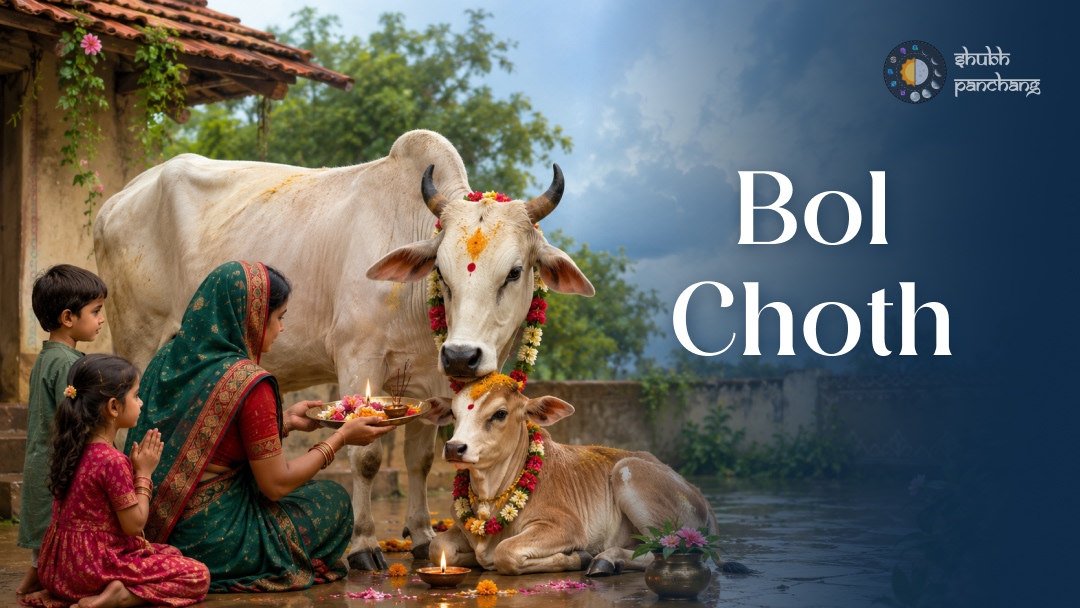
Rituals for Bol Choth begin with a morning bath followed by the preparation of a dedicated worship space where a cow and calf are honored. Women who observe the fast traditionally avoid consuming cow's milk or any milk-derived products on this day, ensuring that the calf receives the full share of its mother's nourishment. In urban settings where live cattle may not be accessible, clay idols of a cow and calf are used for the 16-step Shodashopachara Puja. Offerings of sprouted grains, specifically mung or chana, and grass are made to the animals. The day concludes with the reading of the Bol Choth Vrat Katha, which is believed to bring peace and protection to the household.
Traditional Dietary Rules and Fasting Customs
Fasting rules for Bol Choth are unique and vary by family tradition, but they generally involve the avoidance of specific food items like wheat and milk. Many Gujarati households prepare a simple meal consisting of bajra rotla (millet flatbread) and mung beans, emphasizing a return to primitive or rural staples. A significant custom followed by many is the avoidance of using knives or any sharp objects to cut vegetables or food, symbolizing a day of complete non-violence and protection. This practice reminds the practitioner of the sanctity of life and the importance of Ahimsa (non-injury) which is a foundational pillar of Vedic lifestyle and spiritual discipline.
Cultural Significance in Rural and Modern Contexts
In rural agricultural communities, Bol Choth remains a vital celebration that honors the cattle who are essential for plowing fields and providing dairy. It serves as an annual reminder of the gratitude owed to these animals. In modern urban environments, the festival has evolved into a day of family bonding where mothers pass down cultural values of compassion and environmental stewardship to the younger generation. While the methods of celebration might adapt—such as using digital platforms to hear the katha or using eco-friendly clay idols—the underlying emotional and symbolic aspects of motherhood and gratitude remain unchanged, bridging the gap between ancient agrarian wisdom and contemporary urban living.