






Beyond the Fear: My Personal Journey with Cosmic Timing
I’ve noticed something quite peculiar over my years of practicing astrology—whenever I mention 'Rahu Kaal' in a casual conversation, people tend to freeze, almost like a deer caught in headlights. It’s as if those two words carry a weight of impending doom. But why? Is it really that terrifying? Honestly, after decades of observing the sky and advising thousands, I’ve realized these periods aren’t cosmic traps designed to ruin your life. They are more like the 'red lights' on a busy city street. You don't fear a red light, right? You just wait for it to turn green. Think of the Panchang as your cosmic GPS, helping you navigate through the ebbs and flows of planetary energy without crashing into unnecessary obstacles.
Initially, I used to be quite rigid about these timings myself, thinking that even a sip of water at the 'wrong' time might bring bad luck. But here is the thing: wisdom comes with experience, and I’ve learned that these windows of time are tools for awareness, not shackles of superstition. Today, I want to peel back the layers of mystery surrounding Rahu Kaal, Yamagandam, and Gulika. Let’s move away from the academic jargon and talk about how these periods actually work in our modern, fast-paced lives.
The Three Shadows: What Are They Exactly?
Understanding the Trio
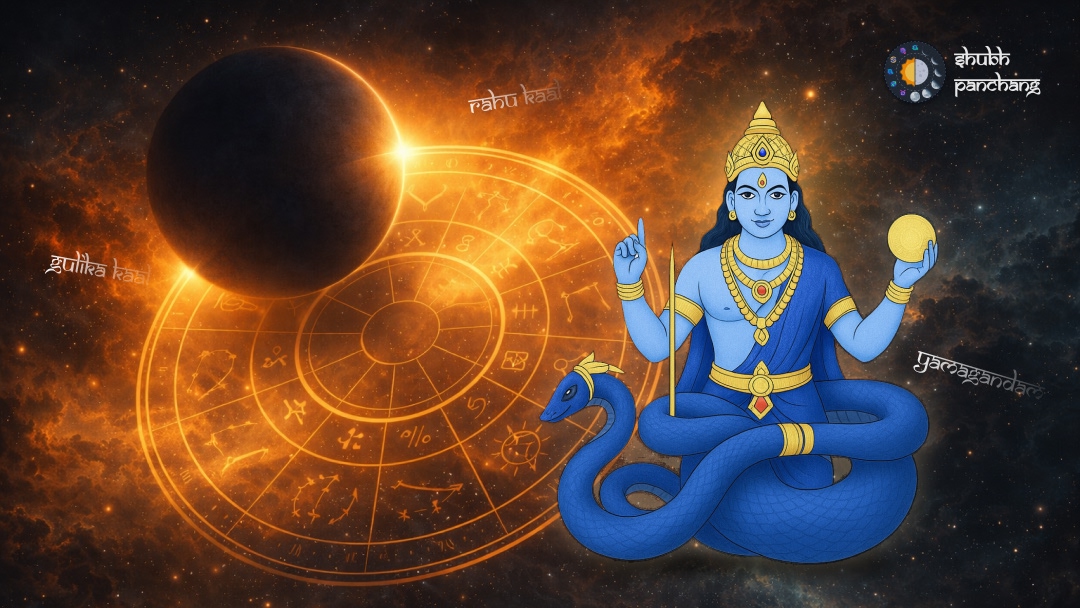
In the Vedic tradition, our day is divided into eight segments between sunrise and sunset. Three of these segments are particularly notable because they are associated with 'Upagrahas' or shadow entities. Rahu Kaal is the period governed by Rahu, the North Node of the Moon. Yamagandam is linked to Yama, the God of Death (or more accurately, the God of Justice and Endings). Gulika , also known as Maandi, is considered the son of Shani (Saturn).
The Calculation Logic
What’s fascinating is how these are calculated. We take the total duration of daylight (from sunrise to sunset) and divide it into eight equal parts. On an average 12-hour day, each segment lasts about 1.5 hours. However, because sunrise and sunset times shift every single day, these timings are never fixed. This is why I always tell my clients to check a reliable Panchang every morning. You might think Rahu Kaal starts at 4:30 PM every Monday, but if you're in a different city or the season is changing, you could be off by twenty minutes—and in astrology, those minutes are pivotal!
Rahu Kaal: The Cloud of Illusion
Rahu is the master of smoke and mirrors. He represents our desires, but also our confusion. During Rahu Kaal, the energy in the atmosphere is considered 'polluted' with illusion. I’ve observed that decisions made during this time often lack clarity. Have you ever bought something on a whim and regretted it the next day? Or sent an angry email that you later realized was based on a misunderstanding? That’s the classic Rahu influence. Traditional wisdom suggests we should avoid starting new ventures, signing contracts, or performing sacred rituals like weddings during this time. Why? Because the foundation laid under a cloud of illusion is rarely stable. But here is a little secret: it’s a fantastic time for deep research, cleaning your house, or even shadow work in therapy. Rahu loves digging deep into the hidden parts of the mind!
Yamagandam and Gulika: The Weight of Saturn and Yama
While everyone talks about Rahu, Yamagandam and Gulika are often the silent influencers. Yamagandam is often associated with loss. I usually advise against starting anything that involves long-term financial growth during this window. It’s not that Yama wants to hurt you; it’s just that his energy is about 'completion' and 'ending.' Using it to start a new business is like trying to plant a seed in autumn—it’s just the wrong season for growth. Gulika , on the other hand, is a bit of a trickster. Anything you do during Gulika Kaal tends to repeat itself. I remember a colleague who once had to redo a complicated filing three times because he started it during Gulika. If you do something good, it might repeat, but traditionally, it's seen as a period of delay and frustration for major life events. Interestingly, some practitioners say if you have to perform a funeral rite, Gulika is avoided because nobody wants *that* to repeat!
Myths vs. Facts: Breaking the Chains of Fear
'Astrology is a language. If you understand this language, the sky speaks to you.'
Let’s address the elephant in the room: The fear factor. One of the biggest myths is that Rahu Kaal will cause physical accidents or catastrophic bad luck. That is simply not true. These periods are about the quality of time, not a death sentence. Fact: If you are already in the middle of a project, you don't need to stop working just because Rahu Kaal started. The 'inauspicious' tag applies to the commencement of an action. Another myth is that these periods affect everyone equally. In reality, your personal birth chart (Horoscope) plays a massive role. If Rahu is a well-placed, beneficial planet for you, his 'Kaal' might not be as troublesome as it is for someone else. But for the sake of general harmony, we follow the collective timing of the Panchang .
The Ultimate Loophole: Abhijit Muhurat and Grace
But what if you have an emergency? What if you *must* do something during an inauspicious time? This is where the beauty of Vedic wisdom shines. There is a period called Abhijit Muhurat , which occurs roughly around midday. It is said that Lord Shiva destroyed the demon Tripurasura during this time, and it’s so powerful that it can neutralize many negative influences. If you're stuck in a 'bad' timing window, look for Abhijit Muhurat or seek the grace of your Ishta Devata (personal deity). After years of practice, I’ve realized that sincere intention (Sankalpa) often outweighs minor technicalities in the calendar. However, when we have the choice, why not align with the cosmic flow? It’s just easier, like swimming with the current instead of against it.
Practical Modern Living: How to Use This Knowledge
In our busy professional lives, we can’t always pause everything for 90 minutes. Here is my practical advice: use these timings for 'low-stakes' activities. Use Rahu Kaal for routine admin work, checking emails, or brainstorming. Save the 'high-stakes' activities—like launching a website, proposing to a partner, or signing a mortgage—for the auspicious windows. Wait until you discover how much smoother your day feels when you stop forcing things during the shadow hours. Ultimately, Rahu Kaal, Yamagandam, and Gulika are not there to scare you. They are there to teach you the rhythm of the universe. They remind us that there is a time for action and a time for reflection. So, the next time you see a 'red light' in the Panchang , don't panic. Just take a deep breath, have a cup of tea, and wait for the stars to align. Your success is worth the wait!