





Meeting the Mother in the Shadows
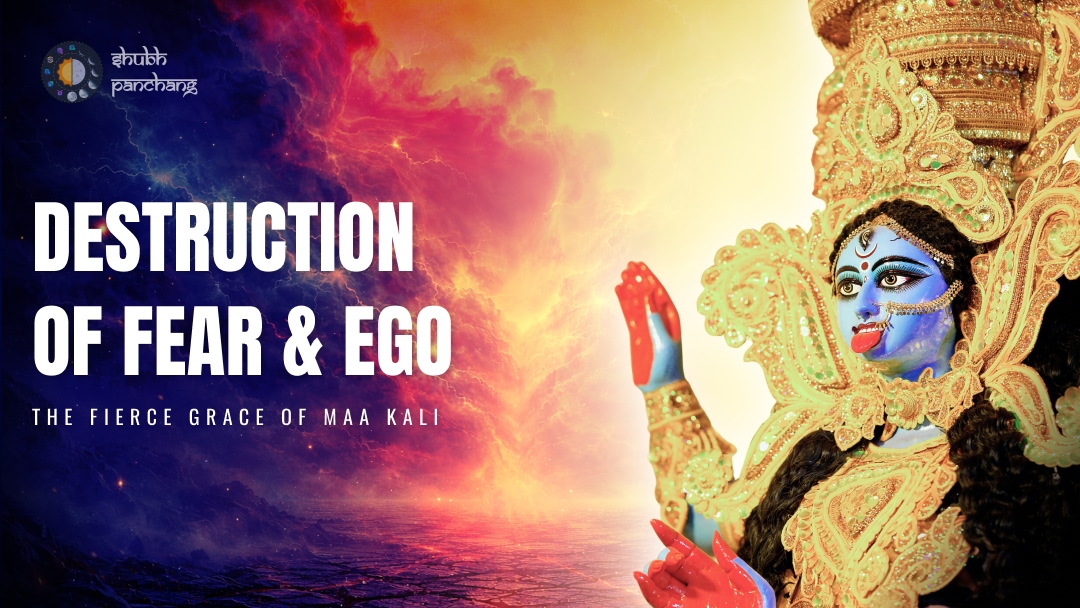
I remember the first time I stood before a Maa Kali idol in a small, dimly lit temple in Kolkata. The air was thick with the scent of hibiscus and incense, and honestly? I felt a shiver run down my spine. It wasn’t just the sight of her—the dark skin, the wild hair, the protruding tongue—it was the raw, unbridled energy that seemed to vibrate in the room. Many people see Kali and think 'violence' or 'chaos,' but after years of sitting with her energy and studying our deep traditions at ShubhPanchang, I’ve realized she is the most misunderstood figure in our pantheon. She isn’t scary because she’s 'evil'; she’s staggering because she’s the absolute truth . We spend our lives building walls of ego and pretending we have forever, and then Kali comes along to remind us that time— Kaal —eventually swallows everything. But here’s the beautiful part: she only destroys what isn’t real. If you’ve ever felt paralyzed by anxiety or trapped by your own self-importance, Kali is the divine surgeon you didn’t know you needed. She cuts away the rot so the soul can finally breathe. But what if I told you her 'scary' form is actually an act of supreme maternal love?
Why the Fierce Form? It is Not What You Think
The Paradox of Divine Wrath
Let’s get one thing straight: Kali's appearance is a deliberate spiritual shock therapy. Interestingly, in our Vedic tradition, we often focus on the gentle, nurturing aspects of the Divine Mother. But life isn’t always gentle, is it? Sometimes we need a fierce energy to break through our stubborn patterns. Her dark complexion—often described as black or deep blue—represents the Nirguna state, the void from which all creation emerges and into which it eventually returns. It’s like looking into the night sky; it’s vast, infinite, and yes, a little bit intimidating because it reminds us how small our daily dramas really are. Her fierce form is a mirror. If we approach her with a heavy ego, we see a terrifying demon-slayer. But if we approach her as a child, we see a mother who is fiercely protecting us from our own ignorance. I’ve noticed that when clients ask for a specific Muhrat for Kali Puja, they aren’t looking for 'luck' in the traditional sense; they are looking for the courage to face their internal shadows. It’s a pivotal shift in perspective—from fearing the darkness to realizing the darkness is just light we haven't understood yet.
The Secret Language of Skulls and Tongues
Decoding the Iconography
Every single element of Maa Kali’s form is a metaphor packed with psychological depth. Let’s talk about that garland of fifty skulls. Initially, I thought it was macabre, but then I learned they represent the fifty letters of the Sanskrit alphabet—the seeds of sound and creation. By wearing them as a necklace, she shows that she has mastered all knowledge and that even our speech and thoughts are ultimately temporary. And that tongue? The most common story is that she stepped on Lord Shiva in a battle-frenzy and stuck out her tongue in sudden embarrassment. But deeper than that, the tongue represents Rajas (passion/activity), while her white teeth represent Sattva (purity). By biting her tongue, she is symbolically controlling her passions with wisdom. Her four arms usually hold a sword and a severed head (representing the destruction of the ego), while the other two hands offer blessings and 'fear not' mudras. It’s a vivid contradiction: 'I will kill your ego, but I will save your soul.' It’s like a cosmic GPS guiding us back to our true nature. When you check the Panchang for auspicious days to meditate on her, you're essentially setting an appointment to face your own truth.
The Dance of Kaal: Time as the Great Healer
The name 'Kali' is the feminine form of 'Kala,' which means Time. What’s fascinating is how we struggle against time every single day. We fear aging, we fear deadlines, and we certainly fear the 'end.' Kali stands there, dancing on the prostrate body of Shiva, reminding us that Time is the only thing that truly levels the playing field. In my practice, I’ve seen how people cling to the past or obsess over the future, missing the 'now' entirely. Kali’s dance is the dance of the present moment. Shiva, lying beneath her, represents the static, unchanging consciousness, while Kali is the kinetic energy (Shakti) that makes the world move. Without her, consciousness is dormant; without him, energy is chaotic. They are the ultimate power couple of the universe! When we surrender to Kali, we aren’t surrendering to death; we are surrendering to the flow of life . We stop trying to control things that were never in our control to begin with. It’s incredibly liberating, though I’ll admit, it takes a lot of 'unlearning' to get there. But hey, that’s why we have her—to do the heavy lifting for us.
Lessons from the Battlefield: The Myth of Raktabija
"Every drop of blood that hit the ground created another demon, until the mother of all battles required the Mother of all forms."
We’ve all heard the story of Raktabija, the demon who could multiply from every drop of his blood. If you think about it, Raktabija is the perfect metaphor for our obsessive thoughts. You try to solve one worry, and three more pop up in its place, right? This is where Kali comes in. She didn’t just fight the demon; she consumed the blood before it could touch the ground. She went to the root of the problem. In our modern Vedic living, we often try to 'fix' our problems on the surface—new job, new car, new relationship. But the 'ego-blood' keeps spilling. Kali teaches us that to truly find peace, we have to swallow our pride and face the messy, raw parts of our subconscious. It’s not about being 'perfect'; it’s about being whole . I’ve often suggested to those going through intense planetary transits that they should look at Kali’s myths not as fairy tales, but as blueprints for emotional resilience. She protects Dharma not by being 'nice,' but by being effective .
Embracing Transformation in Your Daily Life
So, how do we actually 'do' Kali worship in a way that isn't just ritualistic? It starts with honesty. The next time you feel that surge of 'me, mine, myself'—that’s the ego. When you feel a paralyzing fear of what people think—that’s the ego. Kali invites you to offer those feelings into her fire. I’ve found that even just keeping a small image of her can serve as a 'pivotal' reminder to stay humble. You don’t need to be a Himalayan yogi to connect with her. You just need to be willing to let go. Wait until you discover the peace that comes after a 'Kali moment'—that moment where you finally stop fighting a lost cause and say, 'Mother, you handle it.' It’s like a weight lifting off your chest. And it’s surprisingly practical! When you aren’t bogged down by ego, you make better business decisions, you’re a kinder partner, and you’re much more focused. True freedom isn’t the absence of challenges; it’s the absence of the fear of them. So, are you ready to let the Mother dance through your life and clear away the cobwebs? It might be messy at first, but I promise you, the clarity on the other side is worth every bit of the fire.