




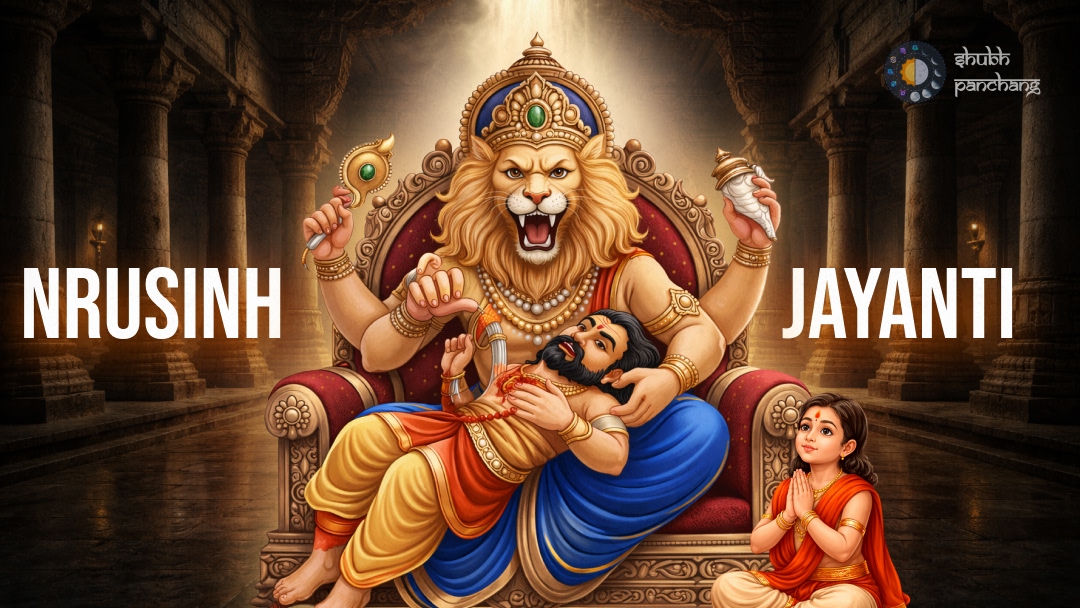
When the Pillar Shattered: My First Encounter with Narasimha
I remember sitting with my grandfather years ago, watching the sun dip below the horizon during a humid summer evening. He told me that this exact moment—the Godhuli Vela or twilight—wasn't just a transition of light, but a crack in reality where the impossible happened. That's the essence of Nrusinh Jayanti . It’s not just a date on the calendar; it’s a cosmic reminder of when the Divine broke through a stone pillar to protect a child. Observed on the Chaturdashi (14th day) of the Shukla Paksha in the month of Vaishakh , this festival marks the appearance of Lord Narasimha, the fourth incarnation of Lord Vishnu. He is fierce, yes, but after years of practice, I've realized His ferocity is purely for the protection of His devotees. It’s like a parent who shows a terrifying face only to the bully threatening their child.
The Rogue King vs. The Little Saint: A Battle of Wills
A Conflict Beyond Time
Initially, I used to think the story of Hiranyakashipu and Prahlada was a simple fairy tale. But look deeper and you’ll see the ultimate psychological drama. You have Hiranyakashipu, a king blinded by ego, and his son Prahlada, whose heart was a fortress of faith. The king tried everything to break the boy—poison, elephants, snakes—yet Prahlada remained unshaken. Interestingly, this struggle is also the preamble to another major festival; you might recall how Prahlada survived the fire that consumed his aunt, a narrative we revisit during Holi celebrations. It shows us that devotion isn't just about chanting; it's about an internal resilience that refuses to bend to external tyranny. Have you ever felt that the world was trying to crush your spirit? That’s exactly where Prahlada stood.
The Ultimate Loophole: Outsmarting a Cosmic Boon
What’s fascinating about this incarnation is the 'divine lawyering' involved. Hiranyakashipu thought he was immortal because of Brahma’s boon: he couldn't be killed by man or animal, indoors or outdoors, at day or night, or by any weapon. He thought he’d outsmarted the Universe. But the Divine is the source of all logic. To honor the boon while ending the tyranny, Vishnu appeared as Narasimha —half-man and half-lion. During Nrusinh Jayanti , we celebrate this pivot from darkness to light. He killed the demon at twilight (neither day nor night), on the threshold (neither inside nor outside), using his claws (not a weapon). It’s a pivotal lesson: arrogance always leaves a loophole, but Dharma is absolute. I’ve noticed that when we think we’ve covered all our bases in life, the Universe often finds a way to remind us who’s really in charge.
The Science of Twilight: Why Timing is Everything
"Godhuli Vela is the bridge between worlds, where the lion roars and the ego falls."
In Vedic astrology and Panchang mastery, timing is everything. Just as your Panchang acts as your cosmic GPS , the timing of Narasimha’s arrival was calculated to the second. Because the demon couldn't be killed during the day or night, the twilight hour became the sacred window for justice. This is why most Nrusinh Jayanti rituals are performed during the evening. I’ve always found it poetic—the sun is setting on evil, and the moon of devotion is rising. If you're looking for a moment to start something that requires immense courage, look at the energy of this Tithi. It’s about the strength that emerges when opposites meet.
How to Honor the Protector: Rituals and Fasting
Celebrating this day isn't just about temple visits; it’s about aligning your vibration with that of the Protector. Many devotees observe a strict fast, similar to Ekadashi , refraining from grains and focusing on the internal fire of Bhakti . Here’s a practical tip from my years of following these traditions: try to spend the afternoon in quiet contemplation or reading the Vishnu Sahasranama . When evening approaches, perform an Abhishek of a Narasimha idol or picture with milk and honey. Don't worry if you don't have fancy items; Lord Narasimha is satisfied with the 'leaves and water' of a sincere heart. The goal is to invite that 'Pillar-shattering' power into your own life to destroy your inner demons of fear and doubt.
Regional Flavors: From Ahobilam to Your Home
A Journey Through Tradition
While the story is universal, the celebrations vary beautifully across the landscape of India. In South India, particularly in places like Andhra Pradesh and Telangana, the devotion is palpable. Temples like Ahobilam see thousands of pilgrims who witness grand Kalyanotsavams . The energy there is electric—you can almost feel the vibration of the roar in the air! But even if you aren't at a major pilgrimage site, the spirit remains the same. Families come together to sing Stotras and share stories. It’s a time when traditional wisdom meets contemporary needs, reminding us that even in our busy modern lives, we need a 'Lion-Heart' to navigate daily challenges. Wait until you experience the peace that follows a Narasimha puja; it’s like a heavy weight has been lifted from your chest.
Finding Your Own Pillar of Faith
Initially, I thought Narasimha was only about anger. But then, after years of meditation, I realized He is the purest form of love. Why? Because only someone who loves you deeply would become a monster to save you from one. This Nrusinh Jayanti , I challenge you to look at the 'pillars' in your life—those rigid beliefs or obstacles that seem immovable. But what if I told you that the Divine is already inside that pillar, waiting for you to call out with the sincerity of Prahlada? True devotion doesn't just ask for help; it expects it with absolute certainty. As we wrap up this exploration, remember that no matter how powerful the evil or how tight the boon, Dharma always finds a way. May the roar of Lord Narasimha silence your fears and bring you the peace you deserve.