






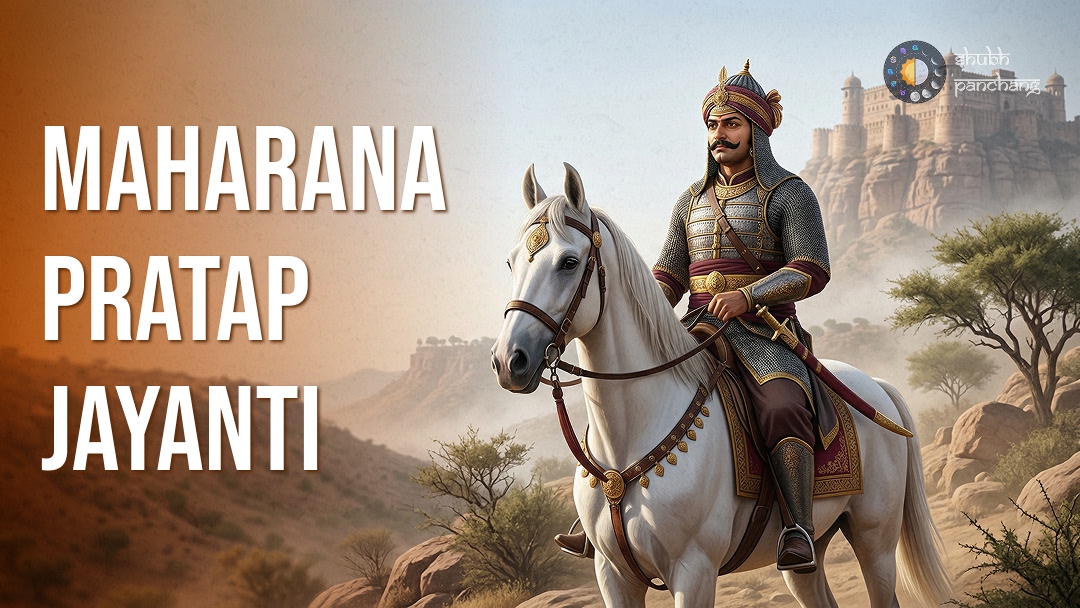
A Day That Echoes Through the Hills of Mewar
The Spirit of a True Legend
Every time I find myself wandering through the rugged terrains of Rajasthan, there is a certain weight in the air—a feeling of ancient pride that refuses to fade. It is not just about the palaces or the sand dunes; it is about the stories etched into every stone. Among these, the saga of Maharana Pratap stands tallest. Maharana Pratap Jayanti isn't just another date on the calendar for me; it is a profound celebration of human spirit and the refusal to bow down to oppression. This day commemorates the birth of a man who was more than a king; he was the heartbeat of resistance. When we observe this day, particularly according to the Hindu lunar calendar on Jyeshtha Shukla Tritiya , we aren't just looking back at history—we are reconnecting with the very essence of 'Dharma' and 'Swaraj'. Have you ever wondered what it takes to stand alone against an empire? That is exactly what Pratap did.
Born for Greatness: The Prince of Kumbhalgarh
Initially, one might think he had an easy path as a royal, but being born in 1540 at the majestic Kumbhalgarh Fort meant inheriting a crown of thorns. His upbringing wasn't just about luxury; it was a rigorous training ground for honor. I’ve often discussed with fellow practitioners how his planetary alignments must have reflected that indomitable 'Surya-vanshi' energy. From a young age, he was steeped in the values of independence and self-respect. His father, Maharana Udai Singh II, saw in him a spark that would eventually ignite the flame of freedom for all of Mewar. He wasn't just a prince; he was a warrior-philosopher in the making, learning that his motherland was more precious than any imperial gold.
The Clash of Titans: Haldighati and Beyond
Resistance Against the Mughal Might
Let’s talk about the Battle of Haldighati . It is perhaps one of the most pivotal moments in Indian history. In 1576, the narrow mountain pass became a witness to a clash that defied all odds. On one side was the massive Mughal army led by Raja Man Singh under Akbar’s command, and on the other, Pratap with his vastly outnumbered but fiercely loyal Rajput and Bhil warriors. But here’s the thing: numbers don't fight battles; hearts do. Despite the overwhelming force, Pratap refused to surrender. His bravery during this battle was so legendary that even his enemies couldn't help but respect him. It wasn't just a territorial dispute; it was a battle for the soul of India. Interestingly, while the Mughals claimed a technical victory, they never actually captured Pratap, nor did they break his spirit.
Chetak: The Horse That Became a Legend
I honestly cannot talk about Pratap without mentioning Chetak . Their bond was almost cosmic. During the heat of the Haldighati battle, when Pratap was cornered, it was his blue-eyed horse that leaped across a wide stream to save his master’s life, despite being mortally wounded. It’s a story that still brings a lump to my throat. Chetak wasn't just an animal; he was a symbol of loyalty and sacrifice. I’ve noticed that in the local songs of Rajasthan, Chetak is celebrated as much as the Maharana himself. It’s a beautiful reminder of the deep connection between humans and the creatures that serve them—a bond built on mutual trust and a shared destiny in the face of death.
The Forest King: Hardships and Grass Rotis
"I would rather eat bread made of grass than serve a master who seeks to enslave my people."
After Haldighati, Pratap's life took a turn that would break most men. He lived in the Aravalli forests, moving from cave to cave. There are heartbreaking stories of his family having to eat rotis made of grass because they had nothing else. Imagine a king choosing such a life when he could have lived in a palace if he had simply accepted Akbar’s suzerainty. This period of his life shows us what true resilience looks like. He wasn't just surviving; he was regrouping, training his people, and never for a second letting go of his dream to reclaim Chittor. This is the part of his legacy that inspires me the most—the ability to find strength in absolute scarcity.
A Celebration of Valor: Modern Observance
Today, Maharana Pratap Jayanti is celebrated with immense fervor. If you ever find yourself in Udaipur or Chittorgarh on this day, the atmosphere is electric. There are massive processions (Shobha Yatras), traditional dances, and tributes at his statues. Schools organize plays, and the air is filled with chants of his name. But beyond the noise, there is a quiet respect. Many families perform special pujas to honor his warrior spirit. It’s a day where the history books come alive, and we teach our children that bravery isn't the absence of fear, but the triumph over it. It’s about keeping the flame of patriotism burning in a world that often forgets its roots.
The Eternal Legacy: Why He Still Matters
An Inspiration for the Ages
So, why do we still talk about a king from the 16th century? Because the values he represented—patriotism, self-respect, and unwavering integrity—are timeless. In our modern, busy lives, we often face moral dilemmas. Should we take the easy path or the right one? Maharana Pratap’s life is a cosmic GPS for our conscience. He reminds us that sovereignty is not just a political term; it’s a personal state of being. He was a true defender of his culture and faith, yet he had the support of diverse groups, including the Bhil tribes and Muslim generals like Hakim Khan Suri. This inclusivity in the face of struggle is a lesson we desperately need today. He didn't just fight for himself; he fought for the dignity of everyone who called Mewar home.
Concluding Thoughts: The Unbroken Spirit
In the end, Maharana Pratap Jayanti is more than a remembrance; it’s a call to action. It challenges us to look within and find our own 'Haldighati'—the challenges where we must stand firm regardless of the consequences. His life teaches us that success isn't always about winning the battle; sometimes, it's about never giving up the fight. As I reflect on his journey, I am reminded that empires rise and fall, but the legacy of a man who lived for his principles remains immortal. This year, as we light a lamp for him, let’s also light a spark of courage within ourselves. What part of his warrior spirit will you carry forward? The world needs more people who, like Pratap, refuse to let their spirit be broken.


