


The Invisible Thread of Cosmic Balance
I’ve noticed something quite telling lately. In my years of practice, clients often come to me asking about their wealth, their health, or their marriages, but they rarely ask about their 'why'. But what if I told you that all those other things—the success, the relationships, the peace—are actually byproducts of something much deeper? I’m talking about Dharma. After years of studying charts and observing the rhythms of life, I’ve come to see Dharma not as a heavy burden of rules, but as the invisible thread that holds the universe together. Think of it as your cosmic GPS. Initially, I thought it was just about religious rituals, but then I realized it’s the very soul of existence. It is the principle that upholds cosmic order , moral duty, and righteous living. Without it, the world would be like a ship without a rudder, tossing aimlessly in a stormy sea.
More Than Just Religion: The Root of Dharma
Interestingly, the word 'Dharma' comes from the Sanskrit root 'Dhr', which literally means 'to sustain' or 'to uphold'. It’s a fascinating concept because it doesn't have a direct English translation. People often use 'religion', but that’s far too narrow. In the Vedic tradition, Dharma is what makes the fire hot and the water flow. It is the inherent nature of a thing. For us humans, it’s about aligning our individual actions with the universal rhythm . I often tell my friends over tea that living your Dharma is like swimming with the current instead of against it. It involves a delicate balance of duty, compassion, truth, and responsibility . It’s not a rigid set of commandments; rather, it’s a living, breathing path that requires us to be present and conscious in every moment. Have you ever felt that deep sense of 'rightness' after doing something difficult but necessary? That’s the feeling of being in alignment with your Dharma.
The Battlefield Within: Lessons from the BhagvadGita
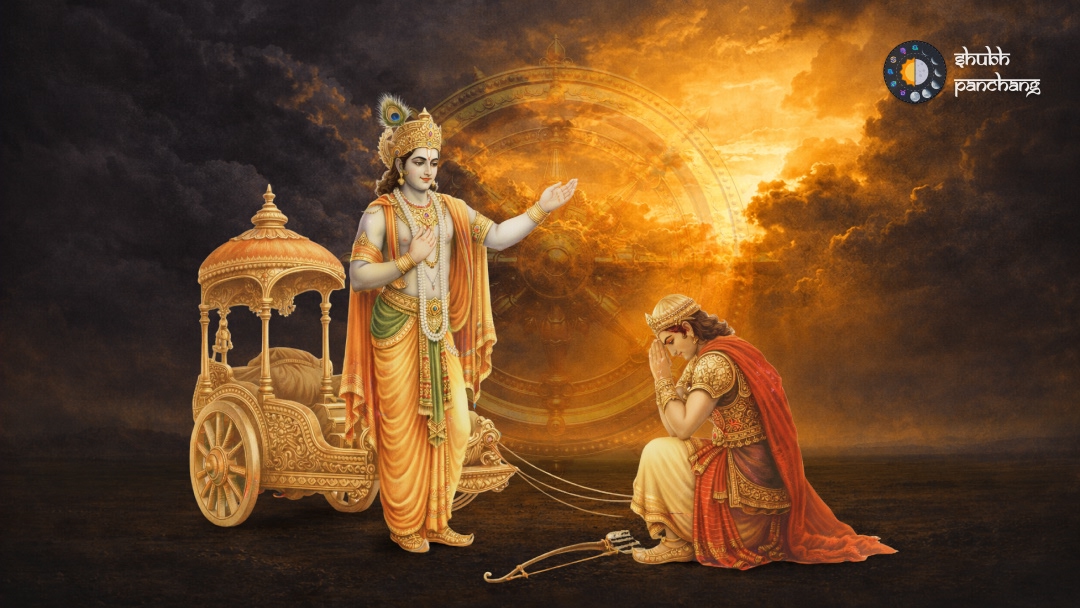
Wait until you discover how this played out on the most famous battlefield in history. When we look at the BhagvadGita , we see Arjuna paralyzed by a moral conflict. He was a warrior, but he didn't want to fight his kin. This is where the concept of Swadharma (one's own duty) becomes pivotal. Krishna didn't give him a generic answer; he reminded Arjuna of his specific role in that specific moment. This is a crucial lesson for us today. Your Dharma isn't my Dharma. A parent's duty is different from a CEO's duty, and a student's duty is different from a teacher's. In the Mahabharata and the Ramayana , we see heroes navigating these gray areas, proving that Dharma isn't always black and white. It’s about making the most righteous choice available to you, even when the options are messy. It’s about integrity over convenience, a lesson that is desperately needed in our modern world.
Dharma in the Age of Distraction
But how do we apply this ancient wisdom to our high-speed, digital lives? Here’s the thing: Dharma is actually more relevant now than ever. In a world where we are constantly bombarded with 'hustle culture' and the pressure to succeed at any cost, Dharma acts as a grounding force. In our professional lives, it translates to personal ethics and leadership. It’s about asking, 'Is this action contributing to the greater good, or just my own ego?' In our relationships, it’s about empathy and compassion . It’s about fulfilling our commitments not because we have to, but because it is the right thing to build a stable society. I’ve observed that when people start viewing their work as a form of service—their professional Dharma—the burnout starts to fade. They find a sense of purpose that goes beyond a paycheck. It’s about bringing ancient wisdom into your daily routine, transforming mundane tasks into acts of righteousness.
Timing Your Actions with Cosmic Intent
What’s fascinating is how Dharma interacts with time. In Vedic astrology, we don’t just look at what to do, but when to do it. Choosing the right Muhrat for a significant event—be it a wedding, starting a business, or even a long journey—is actually an act of Dharma. Why? Because it shows respect for the cosmic timing. It’s an acknowledgment that we are part of a larger system. When we align our intentions with the planetary energies, we are essentially saying, 'I want my actions to be in harmony with the universe.' This isn't superstition; it’s practical spirituality . Just as you wouldn't plant seeds in the middle of a drought, you wouldn't want to start a major life chapter when the cosmic winds are against you. Using these tools helps us navigate modern life with a level of clarity and integrity that is hard to find elsewhere.
Finding Inner Stability and Purpose
At the end of the day, living according to Dharma brings something that money can't buy: inner stability . In my years of counseling, I've seen that the most 'successful' people are often the most anxious because they lack a moral anchor. But those who strive to live righteously, even if they stumble, possess a quiet confidence. They have a sense of purpose and harmony that radiates outward. So, here is my challenge to you: tomorrow morning, don’t just look at your to-do list. Ask yourself, 'What is my Dharma today?' Is it to be a patient listener? Is it to stand up for a colleague? Is it to simply do your job with total honesty? Embrace this context-based path. It’s not about being perfect; it’s about being authentic and responsible . When you start living this way, you’ll find that the universe starts supporting you in ways you never imagined. Navigate your life with this cosmic GPS, and watch how the path clears before you.