






Beyond Stone and Mortar: My First Encounter with Energy
Have you ever walked into an ancient temple and felt an immediate, inexplicable sense of peace?
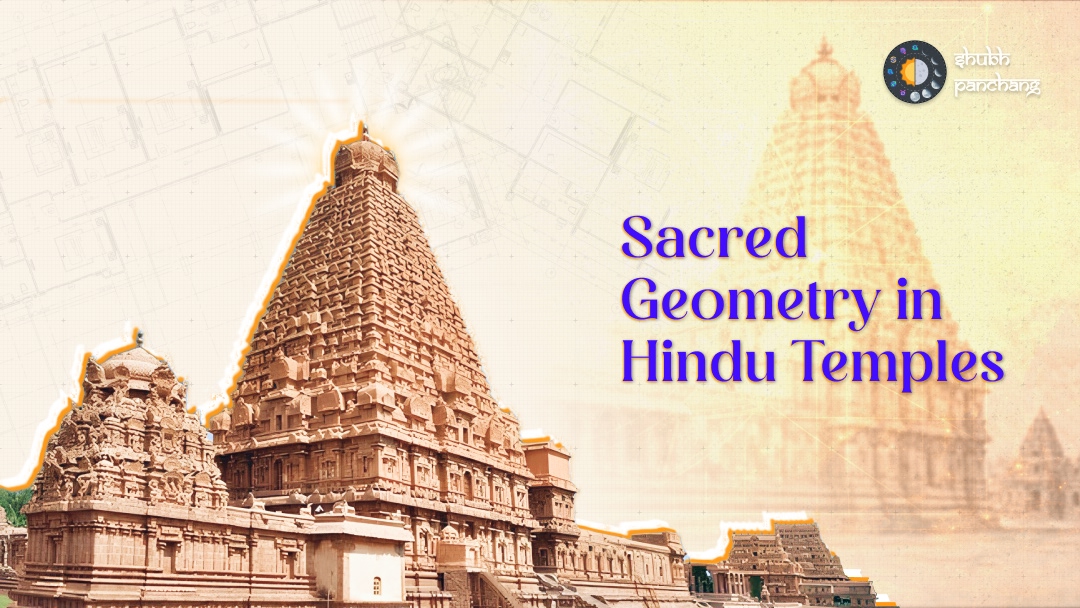
I remember visiting the Brihadisvara Temple years ago, thinking I was just going to see some impressive carvings. But the moment I crossed the threshold, something shifted. It wasn't just the incense or the chanting; it was a physical sensation of alignment. After years of practicing astrology and studying Vedic traditions, I’ve realized that this feeling isn't accidental. It’s the result of Sacred Geometry —a precise, mathematical language that bridges the gap between the mundane and the divine. Just as we use a Panchang as our cosmic GPS to navigate time, the ancient Sthapatis (architects) used geometry to navigate space. They didn't just build walls; they built energetic resonators designed to tune our messy human frequencies back into harmony with the universe. It's fascinating, isn't it? The idea that a building can act as a spiritual tuning fork. Initially, I thought these proportions were just about aesthetics, but then I delved deeper into the Shilpa Shastra, and my perspective changed entirely.
The Vastu Purusha Mandala: The Universe in a Square
At the heart of every sacred structure lies the Vastu Purusha Mandala . Imagine a metaphysical diagram, a square grid that represents the cosmos in a localized form. But what if I told you this isn't just a floor plan? It's a living entity. The 'Purusha' is the primordial man, pressed into the earth by the gods, and his body forms the blueprint of the temple. In my practice, I've seen how the 8x8 or 9x9 grid systems create a fractal-like harmony. The central square, the Brahmasthana , is kept open or dedicated to the main deity, representing the unmanifested source of all creation. This directional alignment is pivotal. Each of the cardinal directions is ruled by a deity (Dikpalas), and by placing specific elements in these corners, the architect ensures that the building breathes with the natural forces of the Earth. It’s like setting the stage for a divine play where every actor knows exactly where to stand.
Garbhagriha and Shikhara: The Womb and the Peak
Wait until you discover the vertical logic of these structures. The Garbhagriha (the womb chamber) is always a perfect square—the most stable and concentrated form in geometry. It’s dark, small, and silent, designed to draw your focus inward. Above it rises the Shikhara , the mountain peak. These towering spires aren't just for show; they are designed using fractal geometry, where smaller versions of the tower are repeated to build the larger structure. This mimics the way mountains grow and how the universe itself is organized. When you look at a Shikhara, your eyes are naturally drawn upward toward the Amalaka and the Kalasha . This isn't just architectural flair—it's a visual metaphor for the soul's journey from the earthly material plane to the peak of spiritual liberation (Moksha). I’ve often sat in the shadows of these towers, and the sheer mathematical symmetry feels like a silent mantra vibrating in the air.
he Math of Stillness: Why Proportions Matter
Interestingly, the proportions used in temple design—based on the 'Ayam' or 'Ayadi' calculations—are meant to resonate with the human body's own energy field. This is where spirituality meets psychology. When we enter a space that is perfectly symmetrical and proportioned according to the Golden Ratio or Vedic equivalents, our brain waves actually begin to shift. I've noticed that in these spaces, the mental chatter slows down. It’s because the geometry provides a visual and spatial order that the mind finds deeply soothing. We spend so much time in chaotic, asymmetrical modern environments that we forget what it feels like to be in a space that 'makes sense' on a cellular level. These temples act as a bridge, using sacred proportions to pull our scattered awareness back into a singular, focused point. It’s a profound union of mathematics and meditation.
Timing the Stone: The Intersection of Space and Time
Here's the thing that many modern enthusiasts overlook: sacred geometry is nothing without sacred timing. You can have the most perfect Vastu Purusha Mandala, but if the first stone isn't laid at the right Muhrat , the energetic foundation is incomplete. In my years of practice, I’ve consulted on many projects where we had to align the physical measurements of the building with the planetary transits of the owner or the deity. The temple becomes a living clock. The shadow cast by the Shikhara during specific times of the year, such as the Solstices or Equinoxes, often falls on precise points within the complex. This level of sophistication shows that our ancestors didn't see architecture, astronomy, and math as separate subjects; they saw them as different facets of the same cosmic truth.
The Actionable Challenge: Finding Your Own Sacred Space
But how does this ancient wisdom apply to your life today? You might not be building a stone temple, but you are building a life. The challenge I want to give you is to observe the 'geometry' of your own home. Is there a central point of peace? Do you respect the cardinal directions? Even a small corner of your room, arranged with symmetry and intention, can become a 'temple' that elevates your awareness. Sacred geometry is a reminder that the universe is not chaotic ; it is a beautifully ordered symphony. By understanding the principles of Vastu and Shilpa Shastra, we learn that our external environment is a direct reflection of our internal state. I encourage you to visit an old temple soon—not just to pray, but to observe. Look at the squares, the circles, and the rising peaks. Feel the math. Let the geometry guide you back to your own center, where the finite and the infinite finally meet.