


Why Sanatan Values Aren't Just Old-Fashioned Rules
I’ve spent years observing families—both in my practice and in my own neighborhood—and I’ve noticed a recurring worry among parents. We are all swimming in a sea of screen time, instant gratification, and a fast-paced culture that often feels disconnected from the soul. But what if I told you that the ancient wisdom of Sanatan Dharma is actually the most modern tool we have? When we talk about Sanatan values, we aren’t talking about rigid, dusty rules from a forgotten era. We are talking about Dharma , which I like to call the cosmic GPS for the soul. Dharma isn't just 'duty'; it's the innate rhythm of doing the right thing because it aligns with the universe. Initially, I thought teaching these concepts to children would be daunting, but I’ve found that kids are naturally spiritual. They understand compassion and respect far better than we give them credit for. By introducing values like Satya (truth) and Ahimsa (non-violence) as living, breathing choices, we give our children an anchor in a world that is constantly shifting beneath their feet.
Swapping Lectures for Legends: The Power of Storytelling
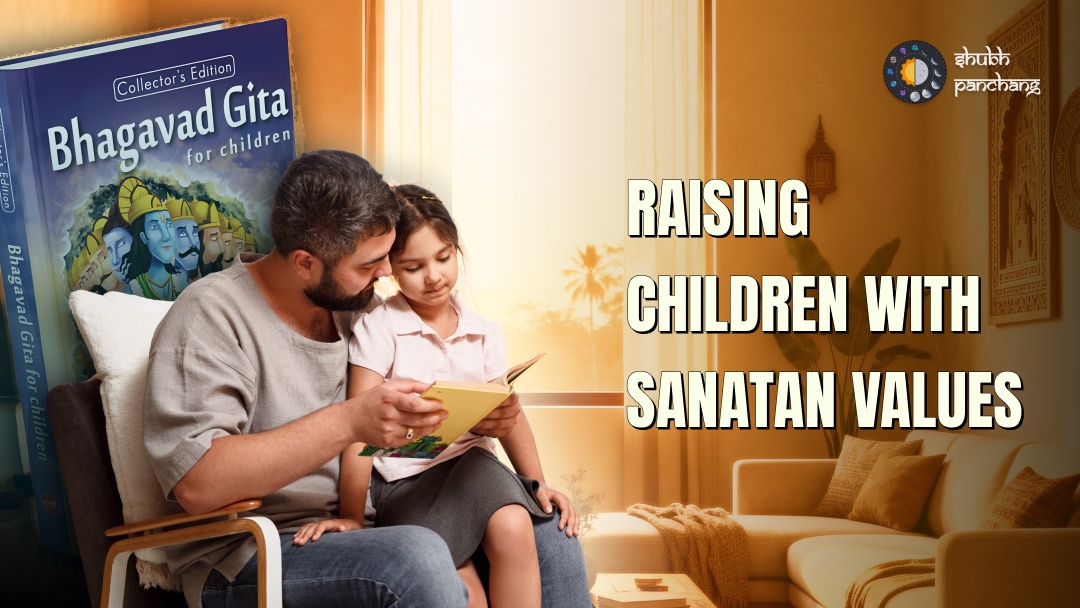
After years of practice, I’ve realized that a child will forget a lecture in ten minutes, but they will remember a story for a lifetime. Why tell a child to be brave when you can tell them the story of young Abhimanyu? Why demand they be loyal when they can walk through the forest with Lakshmana? Our epics—the Ramayana and Mahabharata—are not just history; they are psychological blueprints. Interestingly, I’ve noticed that when parents share these stories over tea or at bedtime, they stop being 'homework' and start being 'hero's journeys.' We can show them that even Sri Krishna had to face complex moral dilemmas, teaching them that life isn't always black and white, but our character is defined by the choices we make. This builds a pivotal foundation for ethical decision-making that no textbook can replicate. It’s about showing them that these heroes are not distant statues, but living examples of how to navigate challenges with grace and grit.
Simple Daily Rituals as a Cosmic Foundation
Wait until you discover how much peace a three-minute ritual can bring to a chaotic household. I’ve always advocated for rituals over 'routines.' A routine is a chore; a ritual is a connection. It could be as simple as lighting a Diya together in the evening or saying a small prayer of gratitude before a meal. What's fascinating is how these moments of stillness help a child’s nervous system regulate. Many parents ask me how to keep their children grounded, and my answer is always to start with the Panchang . By teaching children about the lunar cycles or the significance of a particular Tithi , we connect them to the heartbeat of the Earth. It’s not about being 'religious' in a narrow sense; it’s about recognizing that we are part of a much larger, beautiful pattern. Even checking a muhrat for a special family event—like buying a new bicycle or starting a hobby—teaches them that timing and intention matter in everything we do.
Nature as the Original Classroom
Sanatan Dharma teaches us that the divine isn't just 'up there'; it is right here in the trees, the rivers, and the animals. In my own family, we’ve made it a habit to treat the environment not as a resource, but as a relative. This sense of Vasudhaiva Kutumbakam (the world is one family) starts with a single potted plant on your balcony. When a child learns to water a Tulsi plant or feed a stray bird, they are practicing Karuna (compassion) in its purest form. This is how we raise children who aren't just successful, but kind. I’ve seen how this connection to nature reduces anxiety in children. In a world that demands they always 'do' more, nature teaches them how to 'be.' It’s a vital lesson in harmony that balances the competitive pressure of modern schooling. We aren't just teaching them to survive the world; we are teaching them to belong to it.
Finding the Sweet Spot Between iPads and Upanishads
Here’s the thing: we can’t—and shouldn't—hide our children from technology. But we can give them the spiritual grounding to use it wisely. I’ve often suggested to parents that they look at their child's daily horoscope not to predict the future, but to understand their child’s unique temperament or Swabhava . Is your child naturally fiery? Maybe they need more activities that teach patience. Are they sensitive? They might need more grounding rituals. By balancing modern education with Vedic wisdom, we create a 'whole' child. I’ve seen children who are tech-savvy coders by day and meditative, respectful individuals by evening. It’s not a contradiction; it’s a superpower. This balance ensures they have the intellectual tools to succeed and the spiritual depth to stay humble. It’s about building a bridge between the ancient and the cutting-edge, ensuring they don't lose their soul while chasing their goals.
Building an Inner Compass for Life's Storms
But what if I told you that the greatest benefit of Sanatan values is emotional resilience? Life is going to throw curveballs—failed exams, heartbreaks, or career setbacks. When a child understands the concept of Karma —not as a punishment, but as the law of action and consequence—they feel empowered rather than victimized. They learn that while they cannot control everything that happens, they have total mastery over their response. This is the ultimate form of inner stability. I’ve talked to many young adults who grew up with these values, and they often mention how a simple Shloka or the memory of a family festival gives them strength during tough times. They don't crumble under pressure because they know they are part of a timeless tradition. Their identity is rooted in something much deeper than their social media likes or their grades. They have an inner sanctuary that nobody can take away.
The Greatest Gift We Can Give Our Children
Raising children with Sanatan values isn't about creating clones of ourselves or living in the past. It’s about giving them a compass that will work in any century, on any planet. As a practitioner, my heart fills with joy when I see a child fold their hands in respect not because they were told to, but because they genuinely feel the divinity in the person before them. It takes patience and a lot of 'conscious parenting' rather than just laying down the law. But the result? A generation of leaders who are ethical, compassionate, and vibrantly alive. My challenge to you is this: start small. Pick one story, one ritual, or one moment of gratitude today. Watch how it changes the energy of your home. We aren't just raising kids; we are nurturing the future guardians of wisdom. And believe me, there is no greater or more rewarding journey than that.